Certified EIFS Inspector: 5 Steps to 2025 Success
Why Certified EIFS Inspectors Are Essential for Your Home’s Protection
A certified EIFS inspector is a specially trained professional who examines Exterior Insulation and Finish Systems (synthetic stucco) to detect hidden moisture damage, improper installation, and potential structural issues. Here’s what you need to know:
Quick Answer: What Makes an EIFS Inspector “Certified”?
- Training: Completion of specialized courses from organizations like AWCI, EDI, or InterNACHI
- Focus: Knowledge of proper installation techniques, moisture management, and industry standards (ASTM C1397)
- Cost: Certification ranges from $300-$600, valid for 3-5 years
- Scope: Can inspect new construction installations or conduct forensic evaluations of existing buildings
- Independence: Must be third-party professionals, not employed by contractors or manufacturers
EIFS—commonly called synthetic stucco—looks beautiful from the outside, but it hides a complex multi-layered system underneath. When installed incorrectly, it becomes a ticking time bomb. More than 90% of stucco applications in the Northeastern United States over the past 15-20 years are estimated to be improperly installed. Homes built between 1993 and 2006 face failure rates as high as 90% due to outdated building codes.
The problem? Water gets trapped behind the facade, silently destroying wooden framing and sheathing. By the time you notice dark staining or interior mold, thousands of dollars in damage may already exist.
That’s where certified EIFS inspectors come in. These specialists use advanced tools—infrared cameras, electronic moisture meters, and invasive probes—to detect problems before they become catastrophic. Whether you’re buying a home, selling one, or simply protecting your investment, a certified EIFS inspector can save you from costly surprises.
I’m Gabe Kesslick, and I’ve been detecting and repairing leaks since 2001. As an EDI Level 2 Certified Stucco Inspector, AWCI EIFS Inspector, and BESI Level 2 Certified Building Envelope Forensic Inspector, I’ve seen how proper certification makes the difference between a surface-level check and a thorough evaluation that truly protects homeowners.
The Critical Role of a Certified EIFS Inspector
In building exteriors, a certified EIFS inspector acts as a crucial guardian of property value and safety. Why does certification matter so profoundly? Because EIFS, while offering excellent insulation and aesthetic appeal, is incredibly vulnerable to moisture-related issues if not installed or maintained correctly. The statistics are stark: in the Northeastern United States, where our company Stucco Safe operates, it’s estimated that over 90% of stucco applications in the last 15 to 20 years were improperly installed. This often leads to leaks, mold, and structural damage that can go undetected for years, costing homeowners a fortune in repairs.
A certified EIFS inspector possesses the specialized knowledge and tools to identify these hidden dangers, protecting your investment and ensuring the longevity of your home. We use forensic testing methods to uncover problems that visual inspections simply can’t. This proactive approach prevents costly surprises and gives you peace of mind. For more on the potential issues, you can explore our resources on EIFS Moisture Issues Explained Clearly (Without Getting Soaked) and Synthetic Stucco (EIFS) Problems.

Why EIFS Requires Specialized Inspection
EIFS, or Exterior Insulation and Finish Systems, is not your grandmother’s stucco. Traditional stucco is a cement-based material, while EIFS is a multi-layered, synthetic wall cladding that offers superior insulation. However, this complexity is also its Achilles’ heel. EIFS systems typically include:
- A substrate (the wall structure itself)
- An adhesive layer
- Insulation board (usually expanded polystyrene or EPS)
- A base coat reinforced with fiberglass mesh
- A finish coat that provides color and texture
- Crucially, some EIFS systems also incorporate a water-resistive barrier (WRB) and a drainage plane to manage moisture.
Unlike traditional stucco, which can “breathe” and allow moisture to escape, barrier EIFS systems are designed to be watertight. If this barrier is breached—even by a tiny crack or improper flashing around a window—water gets trapped behind the synthetic layers. This creates a perfect, dark, damp environment for mold growth and wood rot, silently deteriorating the structural integrity of your home. This vulnerability to moisture intrusion and the multi-layered system complexity are why EIFS demands a specialized inspection approach, vastly different from a traditional stucco inspection. Our expertise helps you understand and address these EIFS Moisture Problems.
The Inspector’s Role in New vs. Existing Buildings
The role of a certified EIFS inspector varies significantly depending on whether they are examining new construction or an existing building.
In new construction, our inspectors act as quality control experts. We monitor in-progress EIFS installations, ensuring that every layer is applied correctly, flashings are properly integrated, and drainage systems (if present) are functional. This involves reviewing project-specific details, including the type of EIFS, specified drainage paths, WRBs, adhesives, and trims. Our goal is to ensure compliance with building codes (like IBC Section 1407), manufacturer’s recommendations, and the building’s design. This proactive approach is vital because fixing errors during construction is far less expensive than remediating them years later.
For existing buildings, particularly older ones where EIFS was installed between 1993 and 2006 (a period notorious for high failure rates due to incorrect building codes), our role becomes more forensic. We conduct detailed evaluations to identify hidden damage, moisture intrusion, and structural issues that may have developed over time. This often involves intrusive testing and advanced diagnostic tools to pinpoint problems that are not visible from the surface. Whether it’s a residential property or a commercial building in Southeastern PA, New Jersey, or Delaware, our Commercial EIFS Inspection and Commercial Stucco and EIFS Inspections services are designed to uncover these critical issues.
Your Path to Becoming a Certified EIFS Inspector
Becoming a certified EIFS inspector is a commitment to quality and professional development. It’s a career path that offers the satisfaction of protecting homeowners and ensuring the integrity of complex building exteriors. Here’s how one might start on this specialized journey.
Essential Qualifications and Training Prerequisites
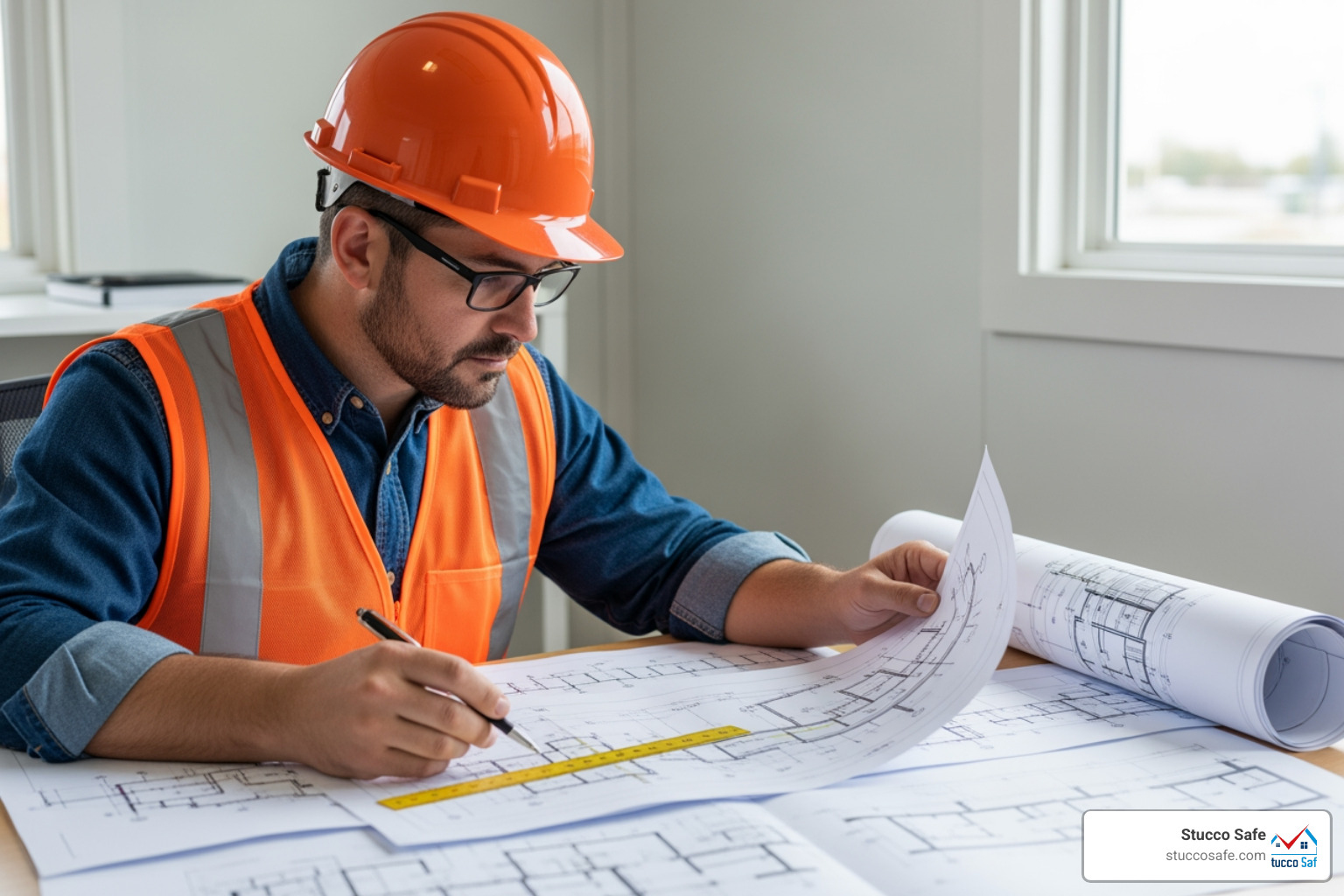
While there isn’t a single, universal prerequisite for becoming a certified EIFS inspector, a strong background in construction, home inspection, or building science is highly beneficial. Organizations offering certification often look for individuals with a foundational understanding of building envelopes, moisture dynamics, and construction practices.
For instance, the Association of the Wall and Ceiling Industry (AWCI) targets its EIFS Inspector certification for individuals from engineering, science, and architecture consulting firms, emphasizing independence from contractors or manufacturers. InterNACHI, on the other hand, typically requires members to complete their general home inspector certification requirements before pursuing specialized EIFS training. The Exterior Design Institute (EDI) emphasizes a comprehensive history of construction and leak detection. Essentially, you need to know how buildings work and how water behaves to truly understand EIFS.
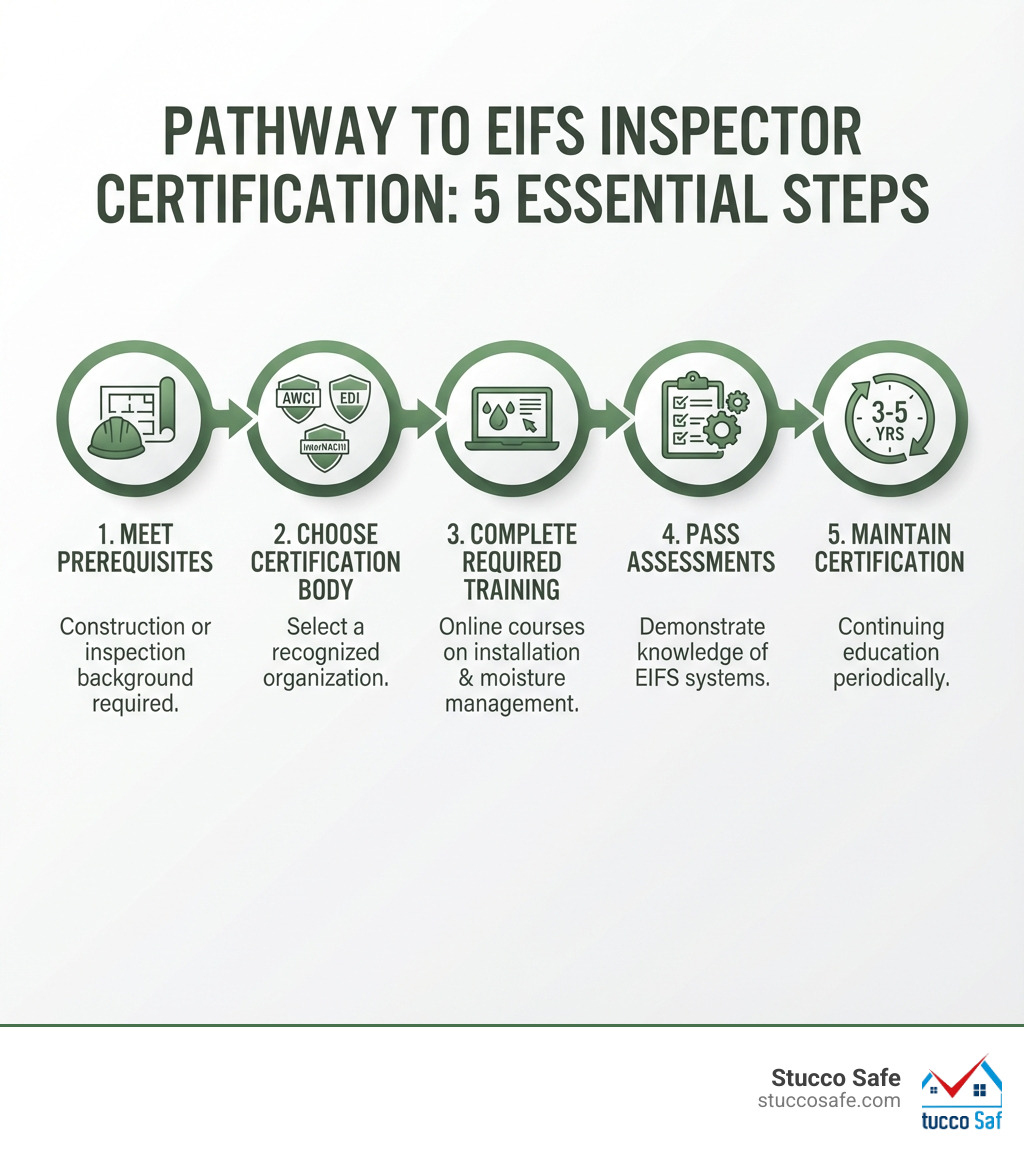
The overview of the EIFS inspector certification process generally includes:
- Foundational Knowledge: Understanding basic building principles.
- Specialized EIFS Training: In-depth courses on EIFS systems, installation, and inspection.
- Assessments: Passing exams to demonstrate proficiency.
- Continuing Education: Ongoing learning to maintain certification.
You can learn more about specific requirements from organizations like the Association of the Wall and Ceiling Industry and InterNACHI.
What to Expect from a Certified EIFS Inspector Training Program
A robust training program for a certified EIFS inspector will dig deep into the intricacies of these systems. The goal is to equip inspectors with the knowledge to identify correct installation procedures and spot deficiencies. Key topics typically covered include:
- Codes and Standards: Understanding relevant industry standards such as ASTM C1397 (Standard Practice for Installation of EIFS) and other ASTM standards like E2568 and E2570. These are the bedrock of proper EIFS application.
- EIFS Design and Installation: Detailed instruction on the components of EIFS, including substrates, adhesives, insulation boards (EPS), reinforcing mesh, base coats, and finish coats. This also covers the proper sequence and techniques for installation.
- Water Management Techniques: A critical component, focusing on how EIFS systems are designed to manage and shed water, including the role of water-resistive barriers (WRBs) and drainage planes.
- Sealant Application: Proper selection and application of sealants around openings (windows, doors) and at transitions to prevent moisture intrusion.
- Flashing Details: The importance of correct flashing at roofs, decks, walls, windows, doors, expansion joints, and parapet walls to divert water.
- Maintenance and Repair: Understanding typical EIFS maintenance needs and common repair methodologies.
- Inspection Methodology: Techniques for visual inspection, use of diagnostic tools, documentation, and reporting.
These programs often involve self-paced online learning modules, assessments after each section, and comprehensive final exams. For example, the AWCI’s EIFS—Doing It Right® program offers online courses covering these topics. You can register for one of these online courses to begin your journey: Register for one of the EIFS—Doing It Right® Online Courses.
Understanding Certification Costs and Timelines
Investing in EIFS certification is an investment in your professional future. The costs and timelines can vary depending on the certifying organization and your membership status.
- AWCI EIFS Inspector Certification: The cost for an EIFS Inspector certification through AWCI is $300 for members and $600 for non-members. Recertification costs $250 for members and $450 for non-members. Certificates are valid for three years.
- InterNACHI: While InterNACHI membership has a fee, many of its specialized courses, including EIFS inspection training, are available to members at no additional cost. This can be a cost-effective route if you’re already a home inspector.
- EDI: Costs for EDI certifications can vary; specific pricing is typically found on their website.
Most online certification programs are self-paced, allowing you to complete them at your convenience. However, there’s usually a time limit to complete the course once you’ve registered.
It’s important to differentiate these certification costs from the cost of actual EIFS inspection services. For homeowners or property managers looking for a certified EIFS inspector in Southeastern Pennsylvania, New Jersey, or Delaware, our comprehensive stucco inspections generally vary in cost from $495 to $1595 or more for very large homes, depending on the size and complexity of the property. This reflects the in-depth expertise, specialized equipment, and detailed reporting involved in a professional inspection.
Choosing Your Certification: What to Look For
When considering which EIFS certification path is right for you, understand that different organizations have different focuses and target audiences. Each plays a vital role in upholding industry standards, but their approaches can differ.
| Certification Body | Target Audience | Primary Course Focus | Recertification Period |
|---|---|---|---|
| AWCI | Independent inspectors, building officials | New construction installation, compliance | 3 years |
| EDI | 3rd-party inspectors, construction/leak detection | Installation processes, comprehensive testing | Varies |
| InterNACHI | Home inspectors | Advanced stucco & EIFS inspection for existing | Varies (CE required) |
Industry-Recognized Certification Standards
Reputable EIFS certifications are built upon widely accepted industry standards. Organizations like AWCI and EDI emphasize adherence to these standards to ensure quality and consistency in both installation and inspection.
- AWCI (Association of the Wall and Ceiling Industry): Their ‘EIFS – Doing It Right®’ program is based on industry standards and best practices, with a strong focus on correct installation for new construction. It prepares inspectors to evaluate EIFS systems for compliance with codes and manufacturer specifications. They specifically require EIFS inspectors to be independent, avoiding conflicts of interest. More details can be found on their main EIFS page: EIFS – Doing It Right – Association of the Wall and Ceiling Industry.
- EDI (Exterior Design Institute): EDI certifications are highly respected, particularly for their emphasis on comprehensive testing methodologies, including both invasive and non-invasive techniques. Their certified inspectors are often well-versed in forensic evaluations of existing buildings. Our own inspectors are EDI Certified, reflecting our commitment to thorough and accurate assessments.
- EIMA (EIFS Industry Members Association): While EIMA doesn’t directly certify inspectors, their guidelines and educational initiatives (like their AIA continuing credit courses) contribute significantly to the body of knowledge that certified inspectors must master. Our inspections adhere to the standards of practice set by EIMA and EDI.
The significance of standards like ASTM C1397 cannot be overstated. This standard provides guidelines for the proper installation of EIFS, which forms the basis for how a certified EIFS inspector evaluates an installation. Understanding these standards is crucial for preventing moisture-related issues and structural damage.
Comprehensive Home Inspector Training
For those already working as home inspectors, or aspiring to be, comprehensive training that includes EIFS is a must. Given the prevalence of EIFS, particularly in our service areas of Southeastern PA, New Jersey, and Delaware, a general home inspection without specialized EIFS knowledge is simply incomplete.
InterNACHI offers an excellent pathway for home inspectors to become certified EIFS inspectors. Their ‘Advanced Stucco & EIFS Inspection Training for Inspectors’ course provides the necessary specialized knowledge. This training covers not only the technical aspects of EIFS but also how to integrate EIFS inspections into a broader home inspection service. InterNACHI is known for its extensive online education resources, offering over 1,000 hours of free online education for members, including courses on stucco and EIFS inspection. This makes it a very accessible option for those looking to expand their expertise. You can learn more about becoming certified through them here: Become a Certified Stucco EIFS Inspector.
Mastering the EIFS Inspection Process
A certified EIFS inspector doesn’t just look at a wall; we follow a systematic, multi-step process to ensure no stone (or stucco panel!) is left unturned. This process is built on a foundation of attitude, preparedness, technique, and a thorough close-out.
The Certified EIFS Inspector’s Toolkit and Methodology
Our inspectors employ a sophisticated toolkit and a precise methodology to uncover hidden issues. A visual inspection is always the first step, but it’s never enough. As we’ve seen, problems with EIFS are usually invisible to the naked eye until significant damage has occurred.
Here’s what our methodology typically includes:
- Visual Examination: We start with a thorough visual inspection of the entire EIFS system, looking for obvious signs of damage, cracks, inadequate flashing, improper sealant application, and issues with ground clearance (stucco should be six to eight inches above the ground). We also check for the existence or lack of critical building details like expansion joints, weep screeds, flashings, and kickout diverters.
- Infrared Thermal Imaging: This non-invasive technology allows us to detect temperature differences on the wall’s surface, which can indicate the presence of moisture behind the EIFS. While it doesn’t directly measure moisture, it helps us identify areas that warrant further investigation.
- Electronic Surface Moisture Scanning: Using non-invasive moisture meters, we scan large areas of the EIFS to identify liftd moisture levels within the system. This helps create a moisture profile of the building.
- Invasive Probe Testing: This is where we get forensic. We drill small, inconspicuous 3/16th-inch holes into the EIFS at strategic locations identified by the visual and non-invasive scans. Through these holes, we insert pin probes from advanced moisture meters (like Extech meters, which offer a 1-100% reading range for greater accuracy than typical meters) to directly measure moisture content in the substrate and framing behind the EIFS. We also use resistance probes to determine the integrity of the substrate. These holes are then filled with color-matched caulk.
- Substrate Firmness Testing: This test helps assess the condition of the substrate behind the EIFS, indicating if wood rot or deterioration has occurred.
For a more detailed look at what we check, you can refer to our EIFS Inspection Checklist and explore Check It Off: The Complete EIFS Inspection Checklist. Our adherence to EIFS Inspection Best Practices ensures a thorough and accurate assessment.
Recognizing the Limitations of an EIFS Inspection
While a certified EIFS inspector goes to great lengths to uncover hidden issues, it’s crucial for property owners to understand the inherent limitations of any inspection, particularly a “Phase I” inspection.
According to the International Phase I Standards of Practice for Inspecting Exterior Wall Cladding, inspections are generally limited to “readily accessible and visible portions.” This means we cannot inspect areas that are obstructed, behind furniture, or otherwise hidden without destructive means.
Specifically, a Phase I inspection typically:
- Does not require intrusive testing: While our company does perform invasive testing as a standard part of our service, many basic Phase I inspections might not. It’s important to clarify the scope with your chosen inspector.
- Does not include water testing: Applying water to the EIFS to simulate rain is typically outside the scope of a standard inspection.
- Does not require the use of infrared cameras or removal of wall cladding: Again, while we use thermal imaging, it may not be a standard offering from all inspectors. Removal of cladding is a destructive process and generally only done as part of a remediation effort, not an initial inspection.
- Is not a technically exhaustive evaluation: It aims to identify observable conditions and reasonably findable defects, not to predict future performance or uncover every conceivable hidden flaw.
The inspection is a snapshot in time. We advise clients that all exterior wall cladding should be inspected not less than annually to catch potential issues early. For full details on these standards, you can review the International Phase I Standards of Practice for Inspecting Exterior Wall Cladding.
Building Your Career and Credibility
Becoming a certified EIFS inspector is more than just obtaining a piece of paper; it’s about establishing yourself as a trusted expert in a critical field. This expertise not only fosters professional growth but also significantly improves your marketability.
The Value of Certification for Marketability
For a company like ours, and for individual inspectors, certification is a guide of credibility. When homeowners and real estate professionals in Southeastern PA, New Jersey, or Delaware are looking for an EIFS inspection, they want assurance that they’re hiring someone who truly knows their stuff. This is where certification shines.
- Increased Client Trust: A certified EIFS inspector demonstrates a commitment to specialized knowledge and industry best practices. This builds immediate trust with clients who are often facing significant financial decisions related to their property.
- Company Credibility: For inspection firms, having certified professionals on staff improves the company’s reputation. The AWCI’s ‘EIFSmart Contractor Seal’, for example, is a recognition that reassures general contractors and property owners that a company “knows what they’re doing” when it comes to EIFS.
- Competitive Advantage: In a crowded market, certification sets you apart. It signals to potential clients that you have undergone rigorous training and adhere to high standards. This can lead to more business and allow for premium pricing for specialized services.
- EIFS Home Insurance: In some cases, a comprehensive inspection by a certified EIFS inspector can even impact EIFS Home Insurance considerations, as it provides a clear assessment of the home’s condition.
Ongoing Responsibilities and Recertification
The journey of a certified EIFS inspector doesn’t end with initial certification. The industry is constantly evolving, with new materials, techniques, and standards emerging. Therefore, ongoing responsibilities and recertification are vital to maintaining expertise and credibility.
- Continuing Education Requirements: Most certification bodies, including AWCI and InterNACHI, require inspectors to complete continuing education (CE) hours. This ensures that inspectors stay current with the latest advancements, best practices, and changes in building codes. InterNACHI members, for instance, must abide by a Continuing Education Policy.
- Adhering to a Code of Conduct: Certified inspectors are typically bound by a professional code of conduct, which outlines ethical responsibilities and professional standards. This reinforces trust and accountability within the industry.
- Certificate Renewal Process: EIFS certificates have a limited validity period. For AWCI EIFS Inspectors, certificates are valid for three years, after which recertification is required. This often involves completing additional training or passing a recertification exam. The costs for recertification are typically lower than initial certification (e.g., $250 for AWCI members). You can inquire about recertification options here: Register RegisterGet RecertifiedInquire.
Staying actively engaged in the inspection community and continuously updating one’s knowledge base is paramount for any certified EIFS inspector to remain effective and respected in the field.
Conclusion
Becoming a certified EIFS inspector is a rewarding path for those passionate about building science and protecting property owners. It requires dedication, continuous learning, and adherence to rigorous industry standards. From understanding the complex multi-layered nature of EIFS to mastering advanced forensic testing techniques, a certified EIFS inspector plays an indispensable role in maintaining the health and value of homes and commercial buildings.
The high failure rates of improperly installed EIFS, particularly in our service areas of Southeastern Pennsylvania, New Jersey, and Delaware, underscore the critical need for these specialized professionals. By choosing to become certified, you equip yourself with the knowledge and credibility to identify hidden moisture damage, prevent structural issues, and offer invaluable peace of mind to your clients.
At Stucco Safe, we pride ourselves on our team of expert, certified inspectors who use the latest technology and adhere to the highest industry standards. We believe that an informed homeowner is a protected homeowner. By understanding the intricacies of EIFS and the vital role of certified inspectors, you’re taking a significant step towards safeguarding your investment.
For comprehensive stucco and EIFS services from certified professionals, explore our stucco and drywall painting company solutions.