
Expert Stucco Construction: Find Your Commercial Partner Today
Why Expert Stucco Construction Matters for Your Commercial Investment
Stucco construction involves applying a durable cement-based plaster system to exterior walls, typically in three coats over a metal lath and weather barrier. Here’s what you need to know:
- Traditional System: Scratch coat (adhesion), brown coat (strength), finish coat (appearance)
- Key Components: Portland cement, sand, water, lime, metal lath, weather-resistant barrier
- Critical Success Factors: Proper drainage plane, flashing installation, adequate curing time between coats
- Common Applications: Commercial buildings, residential exteriors, particularly in warm, dry climates
- Professional Installation Required: Multi-coat application demands skilled contractors to prevent moisture intrusion
Stucco has protected buildings for centuries, offering timeless appeal and remarkable durability when properly installed. For commercial properties, it provides both aesthetic versatility and long-term value—but only when the installation follows strict standards and includes proper moisture management systems.
The reality is that stucco’s reputation for durability depends entirely on the quality of installation. Water entering behind improperly applied stucco can cause hidden damage to sheathing and framing, sometimes leading to structural issues that cost tens of thousands to repair. Homes and commercial buildings constructed between 1993 and 2006 face particularly high failure rates due to inadequate building codes during that period.
I’m Gabe Kesslick, and I’ve specialized in leak detection, repair, and forensic stucco construction inspection since 2001. As an EDI Level 2 Certified Stucco Inspector and BESI Level 2 Certified Building Envelope Forensic Inspector, I’ve seen what separates lasting stucco installations from costly failures.
Stucco construction definitions:
Understanding Stucco: Composition and Types
At its heart, stucco construction involves a robust and versatile building material made primarily of aggregates, a binder, and water. This mixture is applied wet and hardens into a very dense solid, serving as a decorative coating for walls, an exterior finish, and even a sculptural medium in architecture. It’s a commonly used substance that can be applied to both exterior and interior surfaces of buildings.
Historically, stucco is one of the oldest building materials, with its roots tracing back to ancient civilizations. Its use has evolved from rudimentary mud-based plasters to the sophisticated systems we see today. The basic composition of traditional stucco was lime, water, and sand, often fortified with animal or plant fibers for added strength. This ancient material formed the backbone of architectural design for millennia, showcasing impressive durability and aesthetic flexibility.
The Building Blocks of a Durable Finish
Traditional stucco, often referred to as hard-coat stucco, is primarily composed of Portland cement, sand, and water. In some traditional formulations, lime is also incorporated. The addition of lime increases the mixture’s workability and permeability, offering a more elastic finish compared to pure cement renders. Interestingly, lime stucco even possesses a limited self-healing property, where slight solubility can fill small cracks over time. Portland cement stucco, while very hard and brittle, became increasingly prevalent in the late 19th century, marking a significant shift in stucco construction.
Modern stucco formulations often include various additives to improve performance. Synthetic acrylics or fibers can be incorporated to improve flexibility and strength, helping to resist cracking and provide better structural properties. These advancements allow for a material that is not only robust but also adaptable to modern building demands. The choice between traditional lime-based, Portland cement-based, or modified stucco depends on the desired properties, climate, and specific application.
Stucco Systems for Commercial Applications
For commercial properties, understanding the different types of stucco systems is crucial for making an informed decision about stucco construction. The two primary categories we encounter are traditional cement-based stucco and synthetic stucco, also known as Exterior Insulation and Finish Systems (EIFS).
Traditional Cement-Based Stucco Systems: These systems typically involve multiple layers (often three coats) of Portland cement plaster applied over a lath and a weather barrier. This method creates a thick, durable, and impact-resistant shell. Many stucco systems include some type of insulation, along with lath, a sheathing board, and a water barrier, all working together to manage moisture and provide structural integrity.
Synthetic Stucco (EIFS): EIFS, sometimes called “synthetic stucco,” is an exterior wall system consisting of foam insulation board covered with a synthetic finish. While it offers excellent insulation and design flexibility, EIFS is distinct from traditional Portland cement stucco. It’s commonly used on large commercial projects, and its successful performance hinges on precise installation, especially regarding moisture management. If incorrectly installed, synthetic stucco adhered to wood or gypsum board can allow water intrusion and cause rot, highlighting the critical need for expert application.
We also see one-coat or two-coat stucco systems, which are variations of the traditional method. These are generally thinner and lighter, often incorporating acrylics and fibers for added strength and flexibility. They can be installed with continuous foam insulation for improved energy efficiency, making them a popular choice for certain commercial applications. Regardless of the system chosen, adherence to installation standards and proper moisture protection is paramount for long-term success.
The Stucco Construction Process: From Lath to Finish
The application of stucco is a multi-step process that requires precision and adherence to established standards. The traditional approach, known as the three-coat system, is a time-tested method that ensures durability and longevity. However, even with modern one or two-coat systems, certain fundamental principles remain consistent to achieve a resilient finish. We typically apply stucco by hand or machine, depending on the scale and specifics of the project. For optimal results, especially in our service areas of Southeastern Pennsylvania, New Jersey, and Delaware, we pay close attention to environmental conditions. For instance, fall temperatures (early to mid 20 degrees Celsius) are often more conducive for uniform stucco installation, as hot summer weather (over 37.8 degrees Celsius) can rapidly dry out the mixture, leading to cracks if not properly hydrated.
Preparing the Foundation: Lath and Weather Barriers
The stucco construction process always begins with meticulous preparation of the wall surface, focusing on waterproofing and creating a proper base for adhesion. This initial phase is crucial for preventing future moisture-related issues.
- Substrate Preparation: Before any application, the existing surface must be thoroughly cleaned and free of dust, debris, or dirt. Any damage to the underlying structure needs to be repaired first; underlying issues cannot simply be covered up with stucco.
- Weather-Resistive Barrier (WRB): For wood or light-gauge steel framing, a vapor-permeable, water-resistant weather barrier (like building wraps or stucco wraps) is applied. This barrier protects the framing from moisture while allowing water vapor generated inside the building to escape. In traditional applications, this is often an asphalt-impregnated felt or paper sheet.
- Lathing: This is the first essential step in the cement stucco process. Lath consists of water-resistant paper, wire mesh, and other metal components that attach to the walls. It serves as the foundation for applying stucco and acts as a primary defense against water intrusion. Metal lath is nailed or stapled approximately every 6 inches to studs and framing members, providing the mechanical bond for the plaster. Furring nails are often used to space the lath slightly from the wall, creating a small gap. Proper installation of lathing and furring, following standards like ASTM C 1063, is critical.
- Weep Screeds and Flashings: Essential for moisture management, weep screeds are perforated flashing installed at the base of the wall, typically at least 4 inches above grade. They allow any trapped water to drain out from behind the stucco system. Equally important are integrated flashings around windows, doors, and other penetrations. These direct water away from the building envelope, preventing it from seeping behind the stucco. The majority of water damage to stucco is often a result of leakage and moisture issues with windows, doors, and roofs, rather than the stucco quality itself, underscoring the importance of proper flashing.
The Traditional Three-Coat System for Stucco Construction
Once the foundation is prepared, the traditional three-coat system builds up the stucco layer by layer, each serving a distinct purpose for strength, adhesion, and finish.
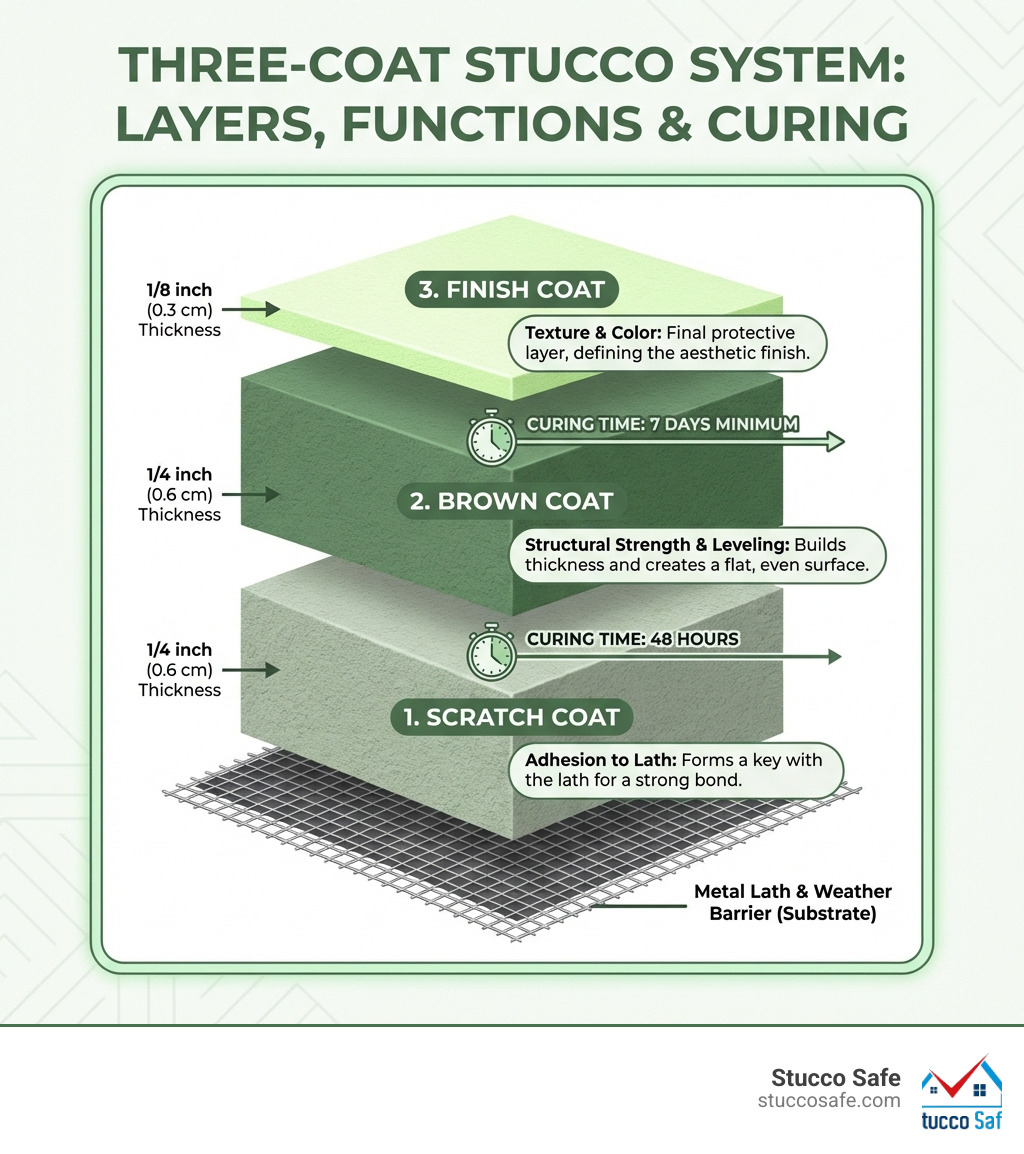
- Scratch Coat: This is the first layer of stucco, a mixture of sand and cement applied directly over the lath. Its purpose is to achieve strong adhesion to the lath and provide a rough surface for the next coat. As the name suggests, it’s often “scratched” horizontally to create grooves that improve mechanical bond. This coat is typically about 1/4 inch thick. Crucially, the scratch coat must be moist-cured for at least 48 hours. If the stucco dries too soon, the chemical hardening (hydration) will be incomplete, resulting in weaker and more brittle stucco.
- Brown Coat: Applied after the scratch coat has adequately cured, the brown coat is a thicker layer of sand and cement, resembling cement. It’s applied to level the surface, achieve the desired thickness, and provide a strong, flat base for the final finish. This coat is also about 1/4 inch thick and requires a minimum cure time of 7 days before the finish coat can be applied. This extended curing period allows for proper setting and strength development, minimizing the risk of shrinkage cracks. If a smooth finish is desired, a “poly prep” step involving crack isolation and cement with polymer, along with fiberglass mesh, may be applied over the brown coat to prevent cracking and ensure adhesion for the final smooth layer.
- Finish Coat: The final layer, typically about 1/8 inch thick, is the color coat. This coat determines the texture and final appearance of the stucco. It’s made by mixing a stucco base (which determines the texture) with a stucco color pack. This final layer is where the aesthetic versatility of stucco truly shines.
The total plaster thickness for a three-coat system with lath is approximately 7/8 inch to 1 inch. This robust layering, combined with meticulous curing, contributes to stucco’s renowned durability.
Modern Finish Options
One of the most appealing aspects of stucco construction for commercial properties is the vast array of aesthetic options available for the finish coat. Stucco can take on many forms and surface appearances, depending on the aggregate, mix, and application technique.
We can achieve a wide range of stucco patterns, including:
- Smooth Finish: A sleek, contemporary look that requires careful application and often the use of poly prep and fiberglass mesh to prevent hairline cracks.
- Dash Finish: Created by “dashing” a wet, coarse mix onto the surface, resulting in a slightly textured, pebbly appearance.
- Pebble Dash or Roughcast: Incorporates small stones or aggregates into the finish, providing a highly textured and robust surface.
- Lace or Swirl Textures: Achieved through various trowel techniques, creating intricate patterns that add depth and character.
Beyond texture, an almost unlimited palette of colors is available for stucco. Pigments can be blended directly into the finish coat mixture, offering long-lasting color retention that often negates the need for repainting. This integrated color ensures a vibrant, fade-resistant exterior for years. Alternatively, stucco can be painted after application, allowing for color changes down the line. This versatility allows commercial properties in Southeastern Pennsylvania, New Jersey, and Delaware to achieve unique and customized exteriors that stand out and improve curb appeal.
Ensuring Quality: Common Problems and Professional Oversight
While stucco construction offers exceptional durability and aesthetic appeal, it’s not without its challenges. The long-term performance of stucco hinges entirely on correct installation, especially regarding moisture management. Unfortunately, we often see common problems arise from installation errors, inadequate materials, or a lack of understanding of building science. When issues occur, they can lead to significant water damage and costly repairs, impacting the value and safety of a commercial property.
Identifying Common Stucco Construction Failures
Understanding the signs of stucco failure is the first step toward effective prevention and repair. We regularly encounter several common issues that can compromise the integrity of a stucco system:
- Cracking: Some hairline cracks are normal in Portland cement stucco due to drying shrinkage. However, larger cracks (exceeding 1/16-inch), spiderweb patterns, or cracks that follow framing lines often indicate structural movement, improper curing, or inadequate base coats. Even hairline cracks can allow water to seep between layers, leading to hidden damage.
- Bulging and Delamination: If stucco is not applied properly, it can bulge or separate from the underlying wall. This delamination creates voids where moisture can accumulate, leading to further damage and potential structural instability.
- Efflorescence: This is a white, powdery residue that appears on the stucco surface, caused by water carrying soluble salts from within the wall to the surface where it evaporates. While a normal occurrence in cement-based products, excessive efflorescence can indicate persistent moisture issues.
- Water Intrusion: This is by far the most critical problem. The majority of water damage to stucco is not due to the quality of the exterior stucco itself, but rather from leakage and moisture issues around windows, doors, and roofs. Improperly installed or missing flashings, kickout diverters, and sealants at these critical junctures allow water to penetrate behind the stucco. This can lead to:
- Hidden Damage: Water gets absorbed into sheathing and framing, leading to rot, mold growth, and eventual structural collapse of supporting wooden elements. Stucco itself is often the last to show signs of this internal damage.
- Interior Signs: Dark staining on the facade, damp interior drywall, or mold spots appearing on internal walls are critical indicators of serious, underlying stucco failure.
- Building Code Issues: Homes and commercial buildings, especially those constructed between 1993 and 2006, have a higher failure rate due to incorrect building codes during that period that did not adequately address moisture management in stucco systems.
Preventing these issues starts with choosing a qualified contractor and ensuring rigorous quality control during installation. However, for existing properties, proactive inspection is key.
The Critical Role of Independent Inspection and Testing
Given the potential for hidden and costly damage, independent stucco inspection and testing are not just recommended—they are often essential, especially for commercial property owners or those involved in real estate transactions in Southeastern Pennsylvania, New Jersey, and Delaware.
We specialize in forensic testing methods and use certified inspectors to provide an unbiased assessment of your stucco system. Here’s why this professional oversight is so critical:
| Feature | DIY Visual Check | Certified Forensic Inspection |
|---|---|---|
| Assessment Depth | Surface-level only | Comprehensive, including hidden structural elements |
| Tools Used | Eyes, hands | Moisture probes, resistance meters, borescopes |
| Moisture Detection | Limited to visible stains/damage | Maps moisture within framing and substrate, even in concealed areas |
| Structural Integrity | Cannot assess | Determines integrity of sheathing and framing behind stucco |
| Code Compliance | Cannot assess | Verifies adherence to ASTM standards and current building codes |
| Reporting | Informal notes | Detailed, actionable report with findings, recommendations, and photographic evidence |
| Cost | Free | $495 to $1595 or more for very large homes (depending on property size and complexity) |
| Reliability | Low, prone to missing critical issues | High, provides accurate, defensible data for repairs or transactions |
| Prevention/Repair | Reactive, often after significant damage occurs | Proactive, identifies issues before they become catastrophic, guides targeted repairs |
| Third-Party Verification | None | Independent, unbiased assessment for peace of mind or transactional leverage |
A comprehensive stucco test involves both moisture and resistance testing. Our certified specialists insert probes through small, discreet holes into the substrate and framing behind the stucco. This allows us to map moisture within the building’s framing and assess the integrity of the underlying structure. This forensic approach, coupled with a thorough visual inspection of critical building details like expansion joints, weep screeds, flashings, kickout diverters, and caulk joints, provides a complete picture of your stucco’s health.
Thermal imaging cameras, while useful for other applications, are not effective for stucco inspections. As we like to say, using a thermal camera for stucco inspection is like bringing a screen door to a submarine – it just won’t work for detecting moisture behind the cladding. For accurate readings, specialized moisture meters, like Extech models, are required, offering a wide and precise range for detection.
We recommend regular stucco testing (every 2 years) for stucco-clad homes and commercial properties. For property owners in Philadelphia, West Chester, Villanova, King of Prussia, Phoenixville, Berwyn, Paoli, Chester County, Bayonne, Brick, Camden, Cherry Hill, Clifton, East Orange, Edison, Elizabeth, Franklin Township, Gloucester Township, Hamilton Township, Jersey City, Lakewood, Middletown, Newark, North Bergen, Old Bridge, Passaic, Paterson, Toms River, Trenton, Union City, Vineland, and Woodbridge, a professional stucco inspection is a vital investment. It helps prevent costly repairs, ensures the longevity of your investment, and provides peace of mind.
Conclusion: Partnering for a Safe and Durable Stucco Investment
Choosing stucco construction for your commercial property is a decision that offers a multitude of benefits, from its enduring aesthetics to its robust performance. When installed and maintained correctly, stucco can be an incredibly durable and valuable asset.
Stucco’s Advantages:
- Durability & Longevity: Stucco is a strong, dense material that protects your building. It’s resistant to fire, rot, mold, impact, and termite infestation. Depending on local climate conditions and proper application, the finish on stucco homes can last as long as 100 years, with general applications lasting up to 50 years. Its ability to expand and contract with temperature changes helps it maintain integrity for decades.
- Aesthetics & Versatility: With an attractively seamless finish and a nearly unlimited palette of colors and textures, stucco offers immense design flexibility. It adds significant curb appeal and can be customized to create a unique and sophisticated look for any commercial building.
- Sustainability: Stucco is made from natural, locally sourced materials like Portland cement, sand, and water, making it a sustainable choice for exterior cladding.
- Energy Efficiency & Insulation: Stucco is a good insulator, boasting higher insulation rates than almost all other exterior finishes. It helps keep interiors warm in winter and cool in summer, contributing to lower energy bills. Stucco is also heat-resistant and fire-resistant, adding a layer of safety.
- Sound Resistance: Stucco siding provides excellent sound resistance, buffering external noise—a major advantage for commercial properties located near busy streets or industrial areas.
- Value Addition: Stucco is an affordable product that significantly adds value to a property. For an estimated $3,000 expense, a property could gain double that amount in added value, potentially up to $7,000. Its growing popularity makes it a fantastic investment.
Stucco’s Performance in Various Climates:
Stucco performs exceptionally well in warmer, drier climates, such as the Southwestern United States, where it’s a predominant exterior finish. Its inherent properties allow it to withstand intense sun and heat. However, in very humid or wet areas, stucco can be challenged. Because it is porous, persistent moisture can lead to crumbling if not properly managed. This highlights why correct installation, including effective moisture barriers and drainage, is paramount in regions like Southeastern Pennsylvania, New Jersey, and Delaware, which experience varying weather conditions.
Maintenance & Lifespan:
While stucco is generally low-maintenance, regular care is essential to maximize its lifespan. We recommend periodic cleaning with a simple remedy of liquid dish soap and water, applied with gentle water pressure and a soft-bristle brush. For mold, mildew, or algae on white stucco, a solution of 1 part bleach to 10 parts water can be effective. Trisodium Phosphate (TSP) solution is another reliable option. Always rinse thoroughly from top to bottom. For any repairs, especially for larger areas or complex damage, hiring a professional is always the best practice to ensure the repair is done correctly and seamlessly.
In conclusion, stucco construction offers a compelling blend of durability, beauty, and performance for commercial properties. However, its success is intrinsically linked to expert application and vigilant oversight. At Stucco Safe, we understand the nuances of this material and the critical importance of ensuring your investment is protected. Our certified inspectors and forensic testing methods provide the independent verification needed to ensure proper installation and identify any potential issues early.
For commercial properties in Southeastern Pennsylvania, New Jersey, and Delaware, partnering with a knowledgeable and experienced stucco professional is the smartest way to safeguard your investment and ensure your stucco exterior performs as intended for decades to come.