

When to Worry About Cracks in Stucco: Causes and Solutions
How to Assess Cracks in Stucco: What’s Serious and What’s Not
Stucco crack assessment is the process of evaluating cracks in your stucco exterior to determine whether they are cosmetic or a sign of a deeper problem — like moisture intrusion, improper installation, or foundation movement.
Here’s a quick guide to crack severity:
| Crack Type | Width | Severity | Action Needed |
|---|---|---|---|
| Hairline cracks | Less than 1/16″ | Cosmetic | Monitor; paint or patch |
| Shrinkage / spiderweb cracks | Less than 1/16″ | Usually cosmetic | Professional assessment recommended |
| Map / patterned cracks | 1/16″ – 1/8″ | Moderate | Inspect for moisture; patch and refinish |
| Wide or diagonal cracks | Greater than 1/8″ | Potentially structural | Call a professional immediately |
| Stair-step cracks | Varies | Serious | Foundation specialist required |
The hard truth? A crack you can barely see could be hiding significant water damage behind your walls. And a home that looks fine on the outside may have rotting sheathing and framing underneath. Stucco is often the last thing to show signs of failure — by the time cracks appear, the damage behind them may already be severe.
This is especially true for homes built between 1993 and 2006, which have an estimated stucco failure rate as high as 90% due to incorrect building codes during that period. And in the Northeastern United States, it’s estimated that more than 90% of stucco applications installed in the past 15 to 20 years were improperly done.
I’m Gabe Kesslick, founder of Stucco Safe and a Building Envelope Forensic Inspector with EDI Level 2 Stucco Inspector certification — I’ve been performing professional stucco crack assessments and leak investigations since 2001. In this guide, I’ll walk you through exactly what different cracks mean, when to worry, and what to do next.

Relevant articles related to stucco crack assessment:
Identifying Different Types of Stucco Cracks
When we walk up to a home in Philadelphia or Cherry Hill, the first thing we do is look at the “language” of the cracks. Stucco doesn’t just crack randomly; it cracks in response to specific stresses. Identifying the type of crack is the first step in a proper stucco crack assessment.
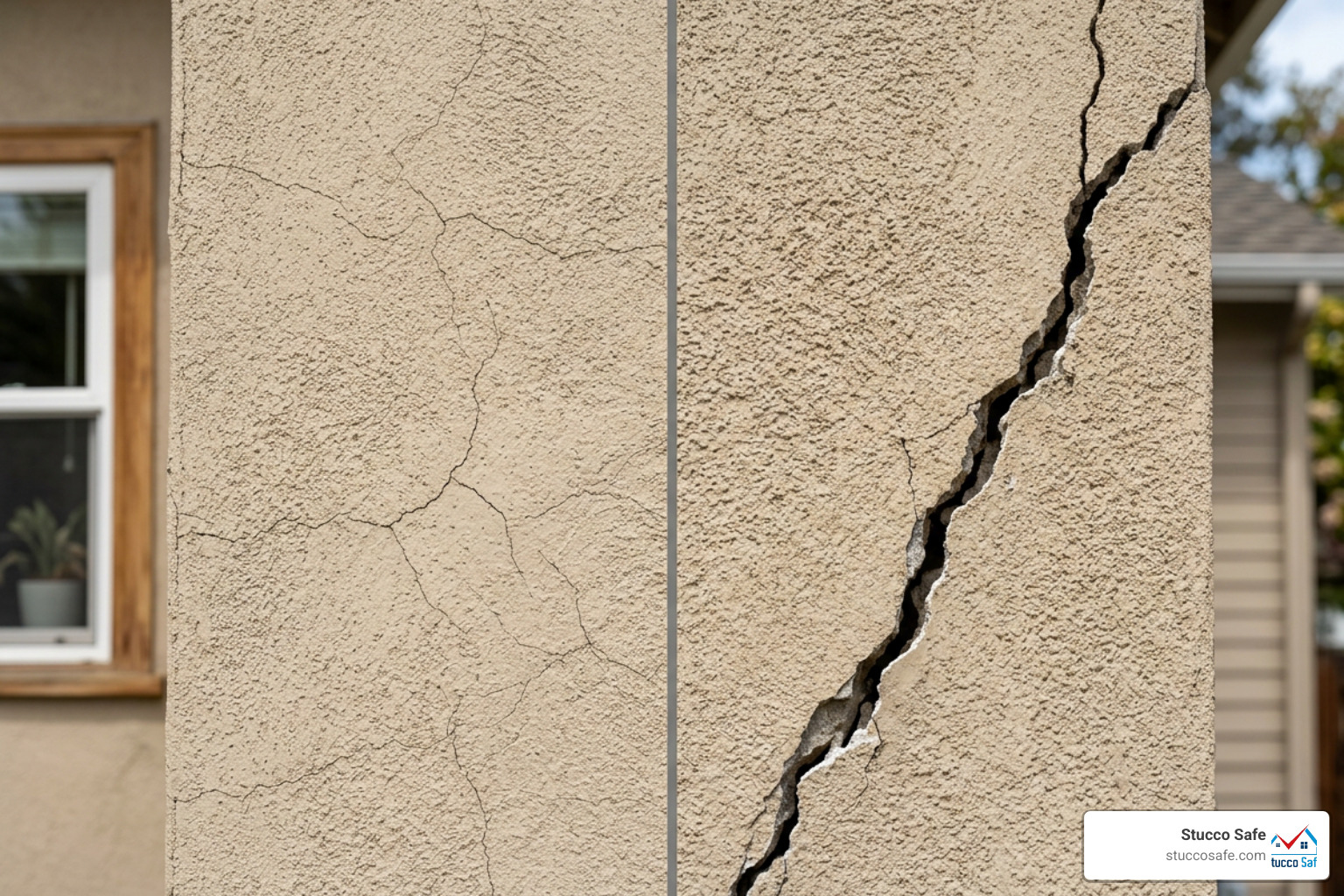
Hairline Cracks
These are the most common. Usually thinner than 1/16 of an inch (about the thickness of a credit card), they are often the result of minor settling or the natural drying process of the stucco. While they are often cosmetic, they can still act as straw-sized straws, sucking water into your wall via capillary action.
Spiderweb Cracks
If your wall looks like a spider had a very busy afternoon, you’re likely looking at shrinkage cracks. These interconnected thin lines often mean the stucco mix had too much water or dried too quickly during installation. While usually superficial, a dense network of these can compromise the “shell” of your home.
Map Cracking
These look like a puzzle or a road map. They are more extensive than spiderweb cracks and often indicate that the base coat didn’t cure properly before the finish coat was applied.
Patterned Cracks
If you see a grid-like pattern—horizontal and vertical lines spaced out—it’s a major red flag. This often reveals the outlines of the lath (the metal mesh underneath) or the edges of the OSB sheathing. This suggests the stucco was applied too thinly or the underlying wood is expanding and contracting due to moisture.
Diagonal Cracks
Typically found at the corners of windows and doors, these are known as “re-entrant cracks.” Small ones are common due to stress concentration at corners, but large diagonal cracks (wider than 1/8 inch) often point to structural shifting or foundation movement.
Stair-step Cracks
These are specific to stucco applied over masonry blocks. If the crack follows the grout lines in a zig-zag pattern, the wall itself is moving. This is a “stop what you’re doing and call an expert” moment.
Cosmetic vs. Structural Stucco Crack Assessment
The million-dollar question: Is my house falling down, or does it just need a “facial”?
Generally, we use the 1/8-inch rule. Anything wider than 1/8 inch is likely structural. However, even a small crack is a problem if you can see the brown coat (the layer under the finish) or the wire mesh. If the mesh is exposed to air and water, it will rust, expand, and pop the stucco right off the wall. You can learn more about the nuances of these patterns in our guide on stucco-cracks.
Visual Patterns in Stucco Crack Assessment
Location matters just as much as width. Cracks at window corners and door frames are common because those are high-stress areas. However, if you see cracks appearing in the middle of a large, flat wall, it often points to a lack of expansion joints. Stucco is like a giant rock wrapped around your house; if it doesn’t have room to grow and shrink with the seasons, it will create its own “joints” in the form of cracks. For residents in our service area, we’ve detailed local findings in our post on are-stucco-cracks-normal-stucco-inspection-in-west-chester.
Common Causes of Stucco Failure and Cracking
Understanding why your stucco is cracking is the key to fixing it correctly. If you just patch the crack without addressing the cause, you’re just putting a Band-Aid on a broken leg.
| Cause | Type of Damage | Severity |
|---|---|---|
| Natural Settling | Hairline cracks at corners | Low |
| Thermal Expansion | Vertical/Horizontal cracks | Moderate |
| Improper Lath | Grid-like patterned cracks | High |
| 1993-2006 Building Codes | Hidden rot/Systemic failure | Extreme |
| Poor Drainage | Dark stains/Soft spots | High |
The “High-Risk” Era (1993-2006)
In Southeastern PA and New Jersey, we see a massive amount of failure in homes built between 1993 and 2006. During this time, building codes often didn’t require an adequate drainage plane behind the stucco. Water would get in, have nowhere to go, and rot the house from the inside out.
OSB Expansion
Most modern homes use OSB (Oriented Strand Board) for sheathing. If water gets behind the stucco, the OSB acts like a sponge. It swells up, pushing against the stucco and causing those straight, vertical cracks we mentioned earlier.
Foundation Issues and Stucco Crack Assessment
Sometimes, the stucco is the messenger for a foundation problem. If your foundation settles unevenly, it twists the wooden frame of the house. Since stucco is rigid, it can’t handle that twist and snaps.
Signs that your stucco cracks are foundation-related include:
- Cracks wider than 1/4 inch.
- Sloped floors inside the house.
- Doors and windows that stick or won’t latch.
- Cracks that continue from the stucco down into the concrete foundation.
If you suspect your foundation is the culprit, check out our guide on how-to-repair-exterior-stucco-cracks for the next steps.
Professional Stucco Crack Assessment and Forensic Testing
When we perform a stucco crack assessment, we don’t just use our eyes. Visual inspection is famously unreliable for stucco because the most expensive damage is usually hidden.
At Stucco Safe, we use forensic testing methods. This isn’t a “home inspection” level check; it’s a deep dive. Here is our process:
- Visual Survey: We identify “hot spots” like windows, kickout flashings, and areas where stucco meets other materials.
- Moisture Probing: We drill tiny, 3/16th-inch holes (about the size of a pencil lead) in inconspicuous areas.
- Extech Meters: We use high-end Extech moisture meters. While cheap probes only read up to 40%, ours read from 1% to 100%. This allows us to tell the difference between “a little damp” and “the wood has the consistency of wet cardboard.”
- Substrate Resistance Testing: We feel the “bite” of the probe. If it pushes through the wood with no resistance, we know the sheathing has rotted away.
- Comprehensive Reporting: You get a full breakdown of the building envelope’s health, including pictures and moisture scores.
This type of testing is essential because, as we always say, the stucco is the last thing to fail. You can find more details on this forensic approach in our ultimate-guide-fix-cracks-exterior-stucco-walls.
Signs of Moisture Damage and Hidden Stucco Failure
Cracks are just one sign of trouble. If you see any of the following along with your cracks, you likely have a moisture intrusion problem:
- Dark Staining: “Stucco tears” or dark streaks running down from the corners of windows.
- Efflorescence: A white, powdery substance on the stucco surface. This is salt being leached out of the cement by water.
- Mold Growth: If you see green or black spots on the exterior, or smell a musty odor inside, water is trapped.
- Damp Drywall: If your interior walls feel cold or damp near a stucco crack, the water has already made it all the way through the assembly.
- Missing Weep Screeds: If the stucco goes all the way into the dirt or covers your foundation, water has no way to drain out of the system.
Often, the failure starts at the kickout flashing—the little piece of metal that’s supposed to direct water from your roof into the gutter. If that’s missing or installed wrong, roof water gets dumped directly behind the stucco wall. For more on identifying these hidden failures, see our article on how-to-fix-cracked-exterior-stucco.
Repair Strategies and Preventive Maintenance
Once we’ve completed the stucco crack assessment and identified the root cause, it’s time for solutions.
For Minor Cosmetic Cracks:
- Acrylic Caulk: High-quality, flexible caulk can fill hairline cracks and prevent water from entering.
- Slurry Coats: A mix of stucco finish and bonding agents can be brushed over fine cracks for a seamless look.
- Painting: Using a “breathable” elastomeric paint can bridge small cracks and add a fresh seal to the home.
For Deeper or Structural Cracks:
- Bonding Agents: These are essential to make sure the new patch actually sticks to the old stucco.
- Re-finishing Panels: To avoid a “patchy” look, we often recommend re-finishing an entire wall panel from corner to corner.
- Addressing the Root Cause: This might mean installing missing kickout flashings, fixing gutters, or even foundation underpinning.
Preventive Maintenance:
- Sealant Maintenance: The caulk around your windows and doors only lasts about 5-10 years. Inspect it annually and replace it if it’s peeling.
- Clearance: Ensure your stucco is at least 6-8 inches above the ground to prevent moisture from wicking up from the soil.
- Regular Inspections: We recommend a professional moisture test every two years to catch problems before they become “rip-it-all-off” expensive.
For a DIY perspective on small fixes, read our guide on how to repair-small-cracks-in-stucco.
Frequently Asked Questions about Stucco Cracks
Are hairline cracks in stucco normal?
In many cases, yes. Because stucco is a cement-based product, it naturally shrinks and expands. However, “normal” doesn’t mean “safe.” Even a small crack can let in water in the right conditions. If you have a lot of them, or they appear in a grid pattern, they need a professional look.
How wide is too wide for a stucco crack?
If you can fit a penny inside the crack (approx 1/16″), it needs to be patched. If you can fit a nickel (approx 1/8″), you likely have a structural or moisture issue that requires a forensic inspection.
Can I just paint over stucco cracks?
You can, but you shouldn’t—at least not without knowing what’s behind them. Painting over a crack that is leaking water will just trap the moisture inside the wall, accelerating the rot of your wooden studs and sheathing. Always test for moisture before sealing cracks with paint.
Conclusion
At Stucco Safe, we’ve seen it all—from minor settling in West Chester to major systemic failures in New Jersey. A stucco crack assessment is about more than just aesthetics; it’s about protecting your biggest investment.
Whether you are buying a new home in Delaware or maintaining your long-time family residence in Philadelphia, don’t guess when it comes to your walls. Our EDI-certified inspectors use the latest forensic technology to give you the truth about your home’s health.
Stucco inspections typically range from $495 to $1595, depending on the size of the home. It’s a small price to pay for the peace of mind that comes with knowing your home is dry and structurally sound.
If you’re seeing cracks and you’re not sure what to do next, we’re here to help. More info about stucco repair services is just a click away. Let’s make sure your home stays safe, dry, and beautiful for years to come.