How to find a water leak underground: 5 Crucial Signs
The Silent Threat Lurking Beneath Your Feet
How to find a water leak underground starts with recognizing the warning signs and knowing when to act. Here’s what you need to know:
Quick Detection Methods:
- Check your water meter – Turn off all water, watch for movement on the leak indicator dial
- Monitor your water bill – Sudden spikes indicate hidden leaks
- Inspect your yard – Look for soggy patches, unusually green grass, or sinkholes
- Listen carefully – Running water sounds when all fixtures are off
- Call professionals – Use acoustic sensors, thermal imaging, or tracer gas detection for pinpoint accuracy
Imagine this: you’re enjoying a sunny afternoon in your yard when you notice a patch of grass that’s inexplicably lush and green while the rest of your lawn looks parched. Or maybe your water bill has doubled for no apparent reason. These aren’t random occurrences—they’re your property crying out for help.
Underground water leaks are a homeowner’s hidden nightmare. Unlike a dripping faucet you can see and fix, these invisible culprits lurk beneath your feet, silently wasting thousands of gallons of water and causing serious damage to your home’s foundation. Left unchecked, they can lead to soil erosion, sinkholes, structural problems, and even dangerous mold growth.
The good news? You don’t need to be a plumbing expert to spot the warning signs or understand your options for detection and repair.
This guide will walk you through everything you need to know: the telltale signs of an underground leak, simple DIY checks you can perform yourself, and the advanced professional methods that pinpoint leaks without turning your yard into a construction zone. You’ll learn when it’s safe to investigate on your own and when it’s time to call in the experts.
As Gabe Kesslick, I’ve spent over two decades investigating moisture intrusion issues and understanding how to find a water leak underground using advanced detection technology. Through my work with Stucco Safe, I’ve helped countless homeowners protect their properties from hidden water damage before it becomes a costly disaster.
The Hidden Dangers: Why You Must Act Fast
When water escapes from a pipe underground, it doesn’t just disappear. It saturates the surrounding soil, creating a host of problems that can quickly escalate from minor annoyances to major crises for your home. We’re not talking about a few drops here and there; a small underground leak can waste thousands of gallons of water per month. This isn’t just bad for the environment; it’s a direct hit to your wallet, leading to skyrocketing utility bills that leave you scratching your head.
Beyond the financial strain, the physical damage an underground leak can inflict is profound. Constant moisture can cause soil to shift or erode, undermining the very foundation of your home. This can lead to costly structural damage, including cracks in your foundation, walls, and even driveways. In severe cases, prolonged water washing away soil can even result in dangerous sinkholes forming on your property. For homes with stucco, this added moisture in the ground can contribute to issues like Stucco Water Stains that migrate up walls, indicating deeper moisture problems.
Furthermore, the excess moisture created by these hidden leaks can foster the growth of mold and mildew, which can begin to develop in as little as 24 hours following water damage, according to the Environmental Protection Agency (EPA). These unwelcome guests can compromise indoor air quality and pose significant health risks to your family. That’s why understanding how to find a water leak underground and addressing it promptly is not just about saving money, but about protecting your home’s structural integrity and your family’s health.
Common Causes of Underground Leaks
Understanding the root causes of underground leaks can help us prevent them and react more effectively when they occur. Several factors contribute to these hidden plumbing nightmares:
- Pipe Corrosion and Aging Infrastructure: Just like us, pipes get old. Over time, materials like cast iron or galvanized steel can corrode, weakening the pipe walls and leading to leaks. Even modern materials like PVC have a lifespan, typically lasting anywhere from 50 to 100 years, depending on the material and installation quality.
- Invasive Tree Roots: Trees are relentless in their search for water. Their roots can grow towards and around underground pipes, eventually cracking, crushing, or infiltrating them to access the water supply. This is a particularly common issue in established neighborhoods across Southeastern PA, New Jersey, and Delaware.
- Shifting Soil and Ground Movement: The ground beneath our homes is rarely static. Seasonal changes, seismic activity (even minor tremors), or settling after construction can cause the soil to shift. This movement can put immense stress on rigid pipes, leading to cracks or disconnections at joints.
- Extreme Temperature Fluctuations: The freeze-thaw cycles common in our service areas of Southeastern PA, New Jersey, and Delaware can be particularly damaging. Water inside pipes expands when it freezes, putting pressure on the pipe walls. When it thaws, the pipe may be left with a crack. Fluctuating temperatures can also cause pipes to expand and contract, leading to fatigue and eventual failure.
- Excessive Water Pressure: While good water pressure is often desired, excessively high pressure in your main water line can put undue stress on your plumbing system, especially older or weaker pipes. Over time, this constant strain can lead to ruptures and leaks.
Telltale Signs: Is There a Hidden Leak on Your Property?
Before we dive into the technical details of how to find a water leak underground, let’s first explore the common indicators that suggest you might have one. These signs are often subtle at first, but paying close attention can save you a world of trouble and expense.
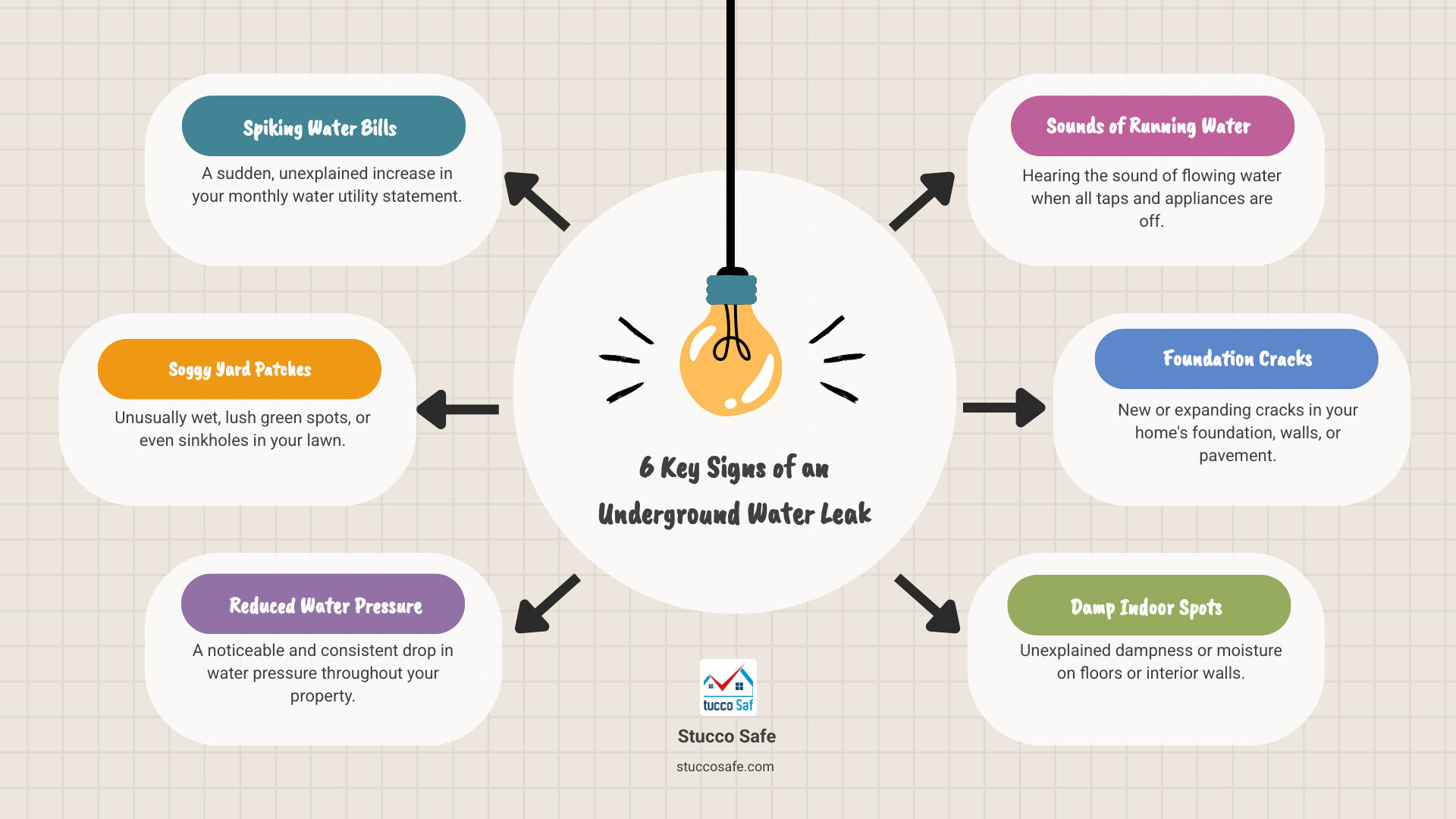
- Sudden Spike in Water Bill: This is often the most glaring red flag. If your water bill suddenly jumps without any changes in your household water usage, a hidden leak is a prime suspect. Even a small leak can lead to a significant increase in consumption over a billing cycle.
- Unexplained Drop in Water Pressure: Are your showers feeling less powerful? Is it taking longer to fill a pot? A noticeable decrease in water pressure or flow volume throughout your home can indicate that water is escaping somewhere before it reaches your faucets.
- Sounds of Running Water: When all your faucets are off, your toilets aren’t flushing, and no appliances are running, your home should be quiet. If you hear a faint hissing, trickling, or bubbling sound coming from beneath the floor or outside, it could be the sound of water escaping a broken pipe underground.
- Damp Spots on Floors or Walls: While this often points to leaks within the home’s structure, a persistent damp spot on your basement floor or lower walls, particularly if it’s not near an obvious fixture, could be a sign of a slab leak or water migrating from an underground pipe. For homes with stucco, we often see this manifest as Moisture Problems with Stucco that originate from below grade.
- Soggy Patches in the Yard or Unusually Lush Vegetation: Inexplicably green patch of grass we mentioned earlier? Water escaping an underground pipe will naturally seek the path of least resistance, often surfacing in a concentrated area. Look for constantly wet or soggy spots, especially during dry weather, or areas where grass and plants are unusually vibrant compared to the rest of your landscaping. This could even lead to small sinkholes forming over time.
- Cracks in Foundation or Pavement: The constant saturation and erosion of soil due to an underground leak can compromise the stability of concrete structures. Keep an eye out for new cracks or an expansion of existing cracks in your home’s foundation, driveways, sidewalks, or patios. The pressure from the escaping water can contribute to these structural issues.
Your First Line of Defense: DIY Methods to Check for Leaks
When you suspect an underground leak, it’s natural to want to investigate yourself. There are indeed several valuable DIY steps you can take to confirm a leak and gather crucial information before calling in the professionals. However, know your limits and prioritize safety.
| Feature | DIY Methods | Professional Methods |
|---|---|---|
| Cost | Low (minimal tools, mainly time) | Moderate to High (specialized equipment, expert labor) |
| Accuracy | Can confirm if a leak exists, but not precise location or severity | Pinpoint accuracy, can locate exact leak spot and assess severity |
| Tools Required | Water meter, food coloring, keen senses (eyes, ears) | Acoustic sensors, thermal imagers, tracer gas detectors, GPR, video cameras |
| Invasiveness | Non-invasive | Non-invasive for detection; repair may involve excavation |
| Time to Detect | Can take hours to days (monitoring water meter, observing yard) | Typically a few hours for detection (depending on complexity) |
| Damage to Property | None | None for detection; minimizes excavation for repair |
| Expertise Required | Basic homeowner knowledge, careful observation | Specialized training, deep understanding of plumbing systems and leak physics |
| Best For | Initial confirmation of a leak, providing clues to professionals | Pinpointing exact leak location, assessing pipe condition, recommending repair |
Safety Considerations: Before you begin any DIY investigation that might involve digging, always call 811 to have utility lines marked. Hitting a gas line or electrical conduit can be incredibly dangerous. Also, if you suspect a significant leak causing structural issues or pooling water, it’s often best to stop and call a pro immediately to avoid further damage or injury. For any issues hinting at a Stucco Leak or Basement Leak, contacting us early can prevent extensive damage.
How to find a water leak underground using your water meter
Your water meter is a powerful, often overlooked, tool in your arsenal for how to find a water leak underground. It can quickly confirm if water is escaping your system when it shouldn’t be.
- Turn Off All Water Fixtures: The first step is to ensure that no water is being used inside or outside your home. This means turning off every faucet, shower, toilet, washing machine, dishwasher, ice maker, and outdoor spigot. If you have an irrigation system, make sure it’s off too.
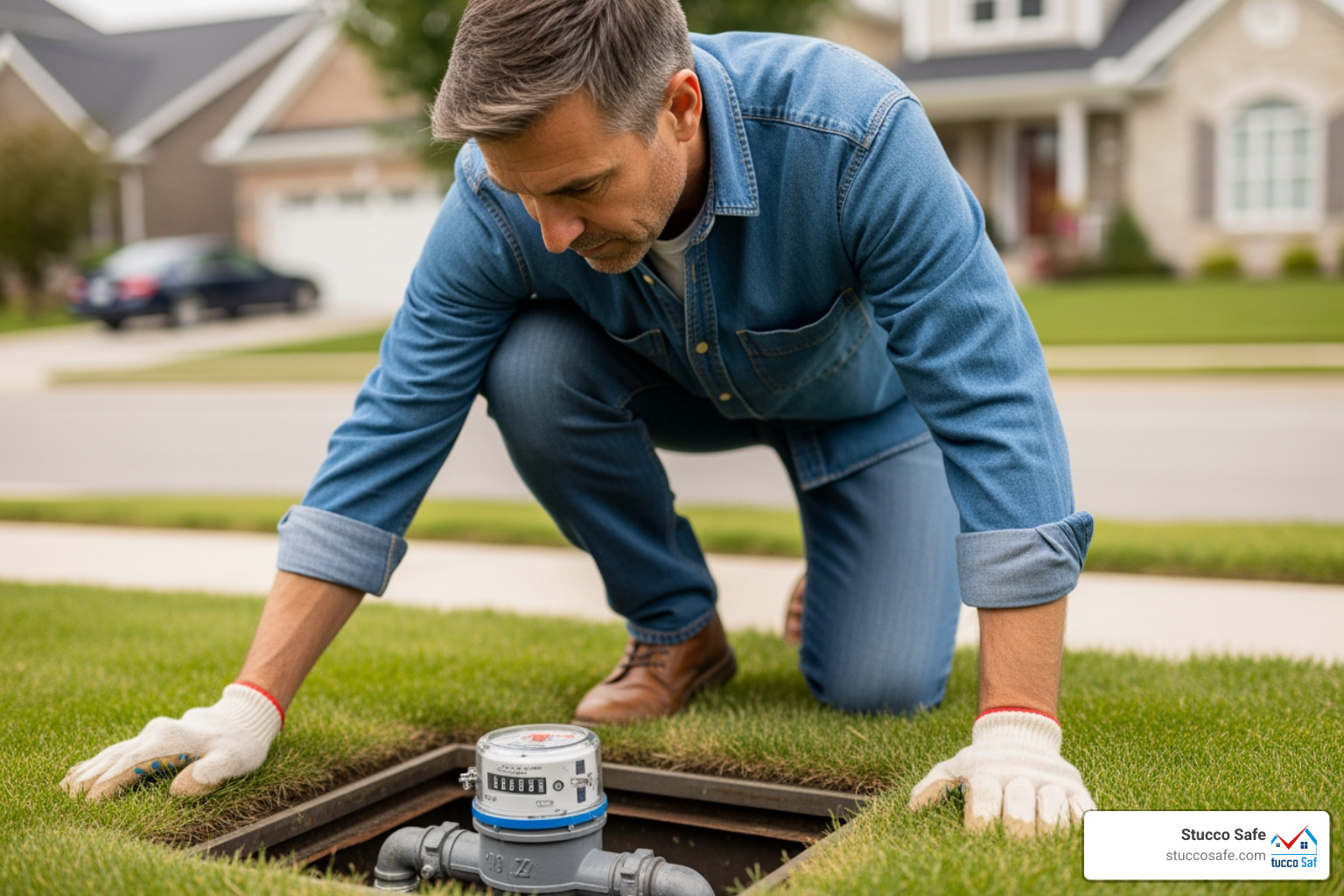
- Locating the Meter: Your water meter is typically housed in a buried box near the street, usually close to your property line. You might need to wear work gloves and scoop away some dirt or debris to access it.
- Checking the Leak Indicator Dial: Most modern water meters have a small leak indicator dial, often a red or blue triangle, a silver wheel, or a small sweep hand. This dial spins even with very small flows of water. If this indicator is moving when all water is off, you almost certainly have a leak somewhere on your property.
- Recording Meter Readings: If your meter doesn’t have a leak indicator, or to confirm a slower leak, record the exact reading on your main meter dial. Then, leave all water-using appliances and fixtures off for a period of 30 to 60 minutes. After this time, check the meter again. If the reading has changed, water has been consumed, indicating a leak.
Simple Checks for Indoor and Outdoor Leaks
Even if your water meter test confirms a leak, pinpointing its exact location can be tricky. These simple checks can help narrow down the search:
- Toilet Dye Test: Toilets are notorious for silent leaks. Add a few drops of food coloring to the tank (not the bowl). Wait about 15-20 minutes without flushing. If the color appears in the bowl, you have a leak in the toilet’s flapper or fill valve. This is an easy fix that can save a lot of water.
- Checking the Water Heater’s Pressure Relief Valve: While not directly underground, a constantly dripping pressure relief valve on your water heater indicates excessive pressure in your system, which can contribute to underground leaks. It’s worth checking to ensure it’s not constantly releasing water.
- Visually Inspecting the Yard for Anomalies: Take a walk around your property with a keen eye. Look for anything out of the ordinary:
- Patches of grass that are significantly greener or taller than the surrounding lawn.
- Areas of soil that are consistently damp or muddy, even days after rain.
- Depressions or small sinkholes forming in the ground.
- Unusual insect activity, as some pests are attracted to moisture.
- Areas where weeds are thriving in an otherwise dry landscape.
How to Find a Water Leak Underground with Professional Help
While DIY methods are excellent for confirming the presence of a leak, how to find a water leak underground with pinpoint accuracy often requires professional expertise and specialized equipment. This is where Stucco Safe and our certified inspectors come in, providing non-invasive, forensic testing methods that save you time, money, and unnecessary property damage.
The benefits of professional leak detection services are numerous:
- Non-Invasive Technology: Our advanced tools can locate leaks without turning your yard into a construction zone. This means less disruption to your landscaping and hardscaping, and ultimately, a faster, cleaner repair process.
- Pinpoint Accuracy: Guessing where a leak is can lead to costly and frustrating excavation. Professionals use precise instruments to identify the exact location, minimizing the area that needs to be dug up for repair.
- Saving Time and Money on Repairs: By accurately locating the leak, professionals can expedite the repair process, reducing labor costs and preventing further water damage that could lead to more expensive fixes down the line.
- Comprehensive Assessment: Beyond just finding the leak, our experts can often assess the condition of your pipes and identify underlying causes, helping you prevent future issues.
- Expert Knowledge: Understanding the nuances of different pipe materials, soil types, and leak signatures requires extensive experience. Our certified inspectors bring this knowledge to every job, especially when dealing with complex moisture issues. You can learn more about our general approach to Leak Detection.
Acoustic Leak Detection: Listening for Clues
One of the most effective and widely used professional methods for how to find a water leak underground is acoustic leak detection. This technique relies on the simple principle that water escaping a pressurized pipe creates vibration and noise.
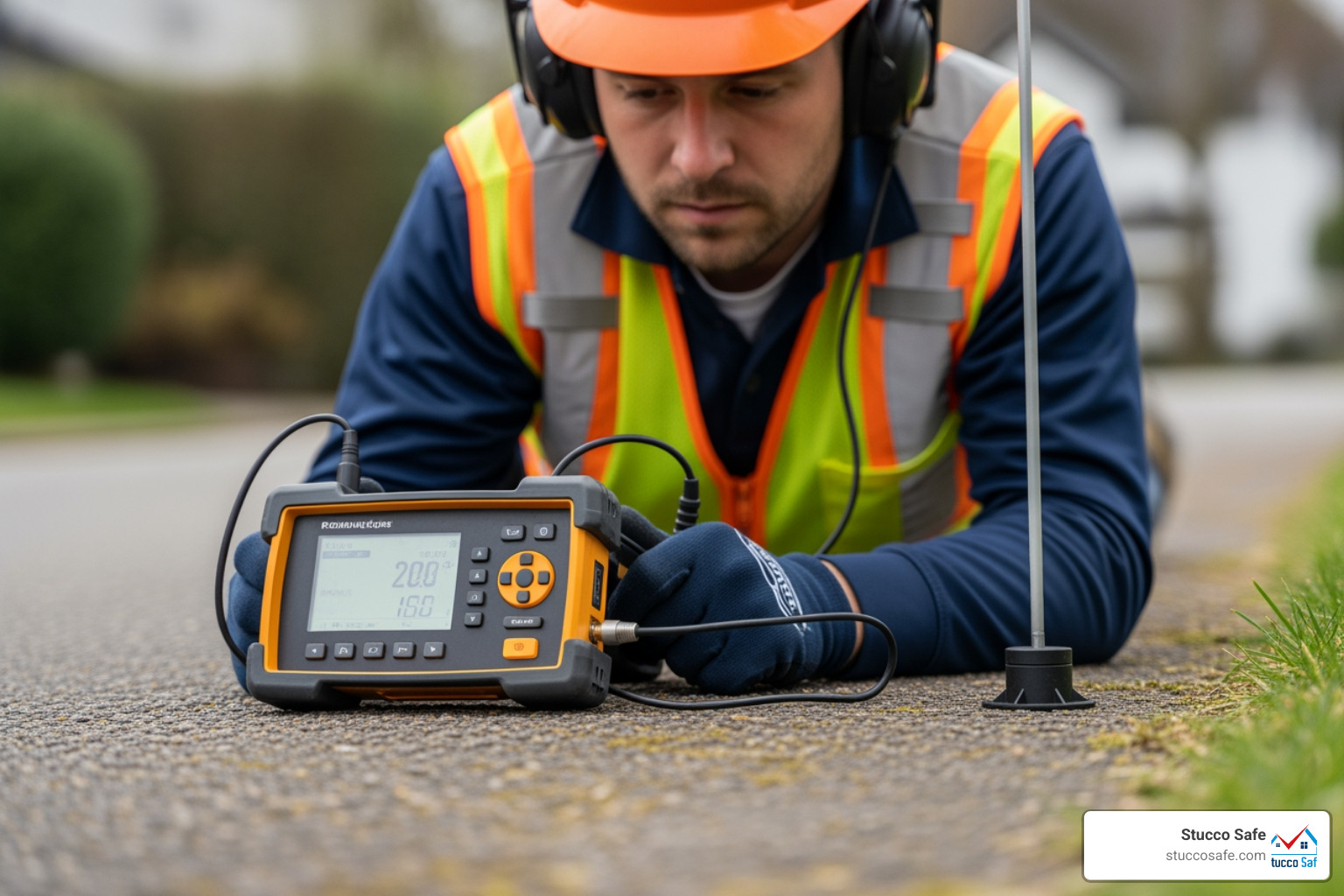
Specialized listening devices, often resembling sophisticated stethoscopes or ground microphones, are used to amplify these subtle sounds. Plumbers and leak detection specialists walk over the suspected pipeline, listening intently for the characteristic “hiss” or “whoosh” of escaping water. The louder the noise, the closer the leak.
However, it’s not as simple as just listening. The way sound travels through soil is complex:
- How Sound Travels Through Soil: Soil absorbs higher frequencies to a greater degree than lower frequencies. This means that for a leak in a pipe 6 feet deep, the “Hiss” or “Whoosh” sound might be weak and “muted,” with only the lower frequencies being audible. For a leak in a pipe 3 feet deep, the sound is generally louder and slightly higher in frequency.
- Factors Affecting Sound: The intensity and clarity of the leak sound are influenced by several factors, including the water pressure, the pipe’s material and diameter, the type and compaction of the soil, the depth of the pipe, and even the surface cover (e.g., pavement vs. grass).
- Minimizing Ambient Noise: For accurate acoustic detection, minimizing ambient noise is crucial. This often means conducting investigations during quiet hours, such as late at night or early morning.
- The “Elephant Foot” Method: This technique involves moving a specialized ground microphone, sometimes called an “elephant foot” due to its shape, every couple of feet from contact point to contact point along the pipe’s path. This systematic approach helps pinpoint the exact location of the leak with remarkable precision.
Acoustic leak detection, as detailed in scientific studies like those found on ScienceDirect, is a cornerstone of non-invasive leak detection.
Thermal Imaging: Seeing Temperature Differences
Another powerful, non-invasive tool in our arsenal for how to find a water leak underground is thermal imaging. This technique uses infrared cameras to detect subtle temperature differences on the ground’s surface that are caused by water escaping from a pipe below.
When water leaks from a pipe, especially a hot water line, it creates a temperature anomaly in the surrounding soil. An infrared camera, like those from FLIR Thermal Imagers, can visualize these temperature variations as different colors on a screen, allowing our inspectors to “see” the leak’s signature without ever breaking ground.
- Detecting Temperature Changes: Hot water leaks are particularly well-suited for thermal imaging because the temperature difference between the escaping water and the cooler surrounding soil is more pronounced. However, even cold water leaks can be detected if there’s a sufficient temperature differential between the leak water and the ground, or if the water has been sitting long enough to significantly change the soil temperature.
- Non-Destructive Method: Thermal imaging is completely non-destructive, meaning it causes no damage to your property during the detection phase. It’s an excellent method for initial surveys and for narrowing down the search area.
- Limitations: While powerful, thermal imaging has its limitations. Its effectiveness is highly dependent on sufficient temperature differentials. Detecting leaks 3 feet deep under concrete, for instance, can be challenging as the concrete acts as an insulator, muting the thermal signature at the surface. Factors like ambient temperature, pipe depth, and soil composition can affect the clarity of the thermal image. For assessing potential Moisture Intrusion Detection that may or may not be from an underground leak, thermal imaging is invaluable.
Other Advanced Professional Techniques
Beyond acoustic and thermal methods, other advanced technologies further improve our ability to precisely determine how to find a water leak underground:
- Tracer Gas Detection: This highly effective method involves introducing a non-toxic, non-flammable mixture of hydrogen and nitrogen (often 95% nitrogen, 5% hydrogen) into the emptied water lines. This “tracer gas” is lighter than air and will escape through even the smallest leaks. Above ground, a specialized gas sensor is used to detect where the gas is escaping, pinpointing the leak location with remarkable accuracy. This method is particularly useful for leaks that are difficult to detect acoustically or thermally.
- Video Pipe Inspection Cameras: For assessing the internal condition of pipes, especially sewer lines or larger water mains, video pipe inspection cameras are indispensable. A small, waterproof camera is snaked through the pipe, transmitting live video feed to a monitor. This allows our inspectors to visually identify cracks, blockages, root intrusion, and other damage, providing a clear picture of the problem’s extent and exact location. This is a key tool in Leak Detection in Stucco Homes Article when assessing drainage issues.
- Ground Penetrating Radar (GPR) and Electromagnetic (EM) Utility Locators: While not directly detecting leaks, GPR and EM locators are crucial for accurately mapping the path of underground utility lines. By creating a visual representation of what’s beneath the surface, we can identify the exact location of water lines and other subsurface infrastructure. This is vital for planning leak detection efforts and ensuring that any necessary excavation is performed safely and precisely, avoiding other buried utilities.
Frequently Asked Questions about Underground Leak Detection
We often hear similar questions from homeowners concerned about potential underground leaks. Here are some of the most common ones we address:
How long does it typically take to detect an underground leak?
The time it takes to detect an underground leak can vary depending on several factors, including the complexity of your plumbing system, the depth of the pipes, the type of soil, and the size of the leak. For straightforward cases, especially with clear indicators, most leaks can be pinpointed within a few hours using specialized equipment. However, more complex situations, such as multiple leaks, very deep pipes, or challenging ground conditions, might require more extensive investigation and could take longer. The good news is that professional tools and systematic approaches significantly speed up the process compared to trial-and-error methods.
Can leak detection methods damage my yard or property?
No, modern professional leak detection methods are specifically designed to be non-invasive and cause minimal to no damage to your yard or property. Techniques like acoustic detection, thermal imaging, tracer gas detection, and GPR allow us to locate leaks with pinpoint accuracy before any digging occurs. This precision prevents unnecessary excavation, saving you the headache and expense of repairing a torn-up lawn, driveway, or patio. Our goal is always to identify the problem with the least intrusive methods possible, ensuring that any subsequent repairs are focused and efficient.
What happens after an underground leak is found and detected?
Once an underground leak is found and precisely located, we will mark the exact spot on your property. Our service is focused on detection and assessment, providing you with a detailed report and recommendations. The next step is typically to engage a licensed plumber to perform the necessary repairs. This may involve carefully excavating the marked area to access the damaged pipe, repairing or replacing the faulty section, and then backfilling the trench.
After the repair, it’s crucial to address any water damage that may have occurred. Depending on the extent of the leak and how long it went undetected, you might need water damage restoration services to dry out saturated soil, prevent mold growth (which can start in as little as 24 hours), and restore your landscaping or hardscaping. Our plumbing inspection costs average around $200, which is a small price to pay to confirm a leak and prevent further damage. If water damage has affected any part of the home, we recommend hiring a reputable water damage restoration company to address any resultant issues. The cost for water damage restoration can range between $1,305 and $5,707, highlighting the importance of early detection to mitigate these expenses.
Protect Your Property from Hidden Water Damage
The thought of an unseen leak silently wreaking havoc beneath your property can be unsettling. But as we’ve explored, how to find a water leak underground doesn’t have to be a mystery or an overwhelming challenge. By understanding the common signs, performing basic DIY checks, and knowing when to leverage professional expertise, you can protect your home from potentially devastating consequences.
Early detection is your best defense. It saves water, prevents skyrocketing utility bills, and most importantly, safeguards your home’s foundation and your family’s health from structural damage and mold. Our non-invasive, professional leak detection services ensure pinpoint accuracy, minimizing disruption and costly repairs.
At Stucco Safe, we specialize in advanced moisture detection and forensic testing methods. Our certified inspectors are experts in uncovering hidden issues, whether they stem from underground leaks or other sources of moisture intrusion. If you suspect a leak or are concerned about moisture problems in your home in Southeastern Pennsylvania, New Jersey, or Delaware, don’t let it lurk any longer.
Contact our moisture detection experts today! Let us help you ensure your home is safe and sound.