Stucco Repair Quotes: How Much Will That Crack Really Cost?
What Do Stucco Repair Quotes Actually Cost in 2026?
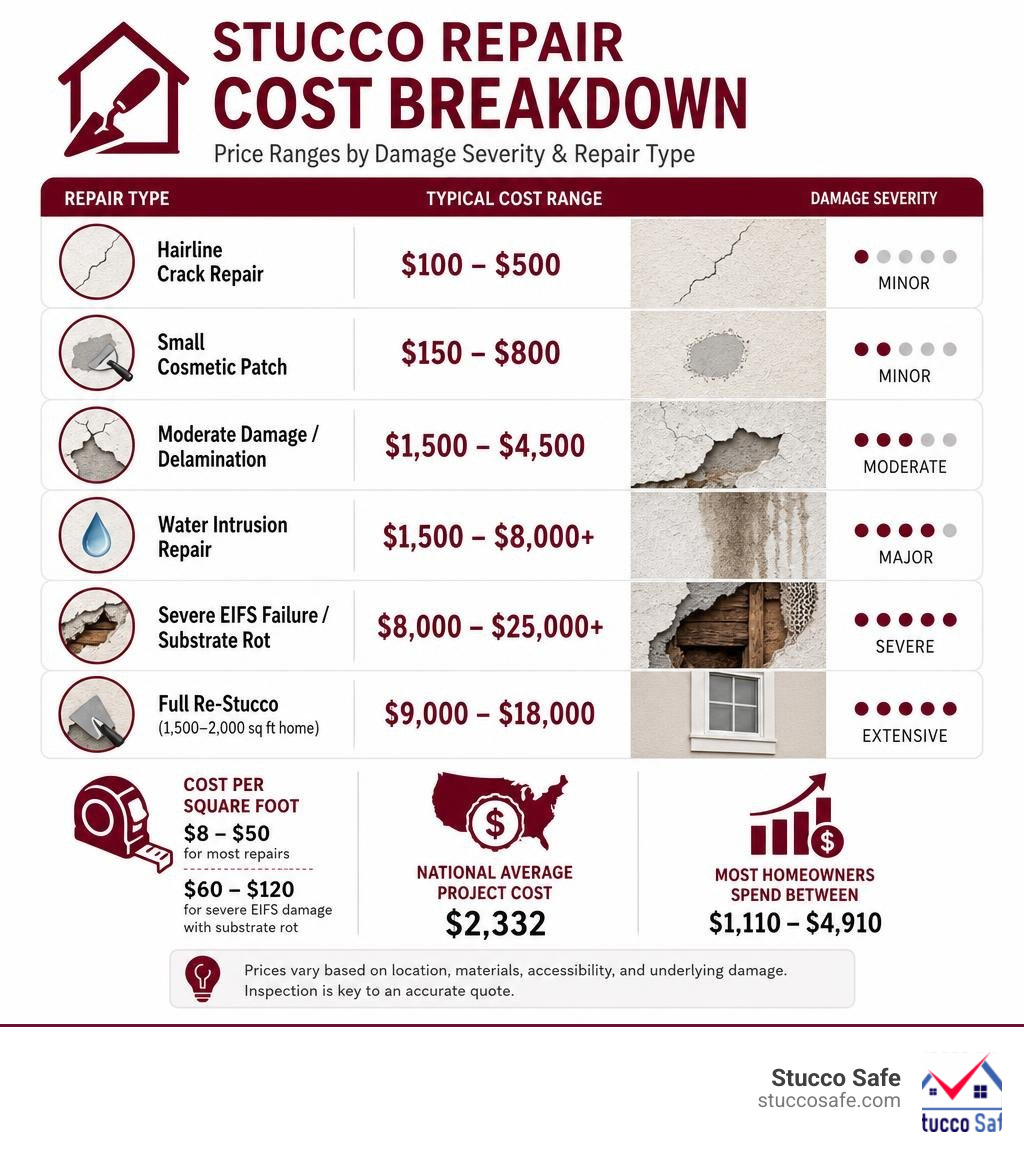
Stucco repair quotes vary widely depending on damage type, location, and materials. Here’s a quick snapshot of what most homeowners can expect to pay:
| Repair Type | Typical Cost Range |
|---|---|
| Hairline crack repair | $100 – $500 |
| Small cosmetic patch | $150 – $800 |
| Moderate damage / delamination | $1,500 – $4,500 |
| Water intrusion repair | $1,500 – $8,000+ |
| Severe EIFS failure / substrate rot | $8,000 – $25,000+ |
| Full re-stucco (1,500–2,000 sq ft home) | $9,000 – $18,000 |
Cost per square foot: $8 – $50 for most repairs, rising to $60 – $120 for severe EIFS damage with substrate rot.
National average project cost: roughly $2,332, with most homeowners spending between $1,110 and $4,910.
That crack in your stucco might look like a simple $200 fix. But what’s behind it could cost ten times more if moisture has been silently working its way into your wall system for months or years.
The tricky part isn’t getting a quote — it’s knowing whether that quote reflects the full problem or just the surface symptom. A contractor who patches visible cracks without checking for underlying moisture intrusion or delamination isn’t solving your problem. They’re delaying a much bigger one.
This is especially important for homeowners in the Mid-Atlantic region, where older stucco systems and wet winters create the perfect conditions for hidden water damage that standard repair quotes simply don’t account for.
I’m Gabe Kesslick, founder of Stucco Safe and a certified forensic stucco inspector with over two decades of experience diagnosing exactly the kind of hidden damage that inflates stucco repair quotes far beyond initial estimates. In the sections below, I’ll walk you through everything you need to know to understand, compare, and critically evaluate the quotes you receive.
Stucco repair quotes word guide:
Understanding Stucco Repair Quotes: National Averages and Cost Per Square Foot
When you begin gathering stucco repair quotes, the sheer variety in pricing can feel overwhelming. In July 2026, the estimated cost to repair stucco starts at approximately $47.92 to $57.84 per square foot for complex, deep-set repairs, while a basic, straightforward surface patch runs closer to $40 per square foot. Nationally, most homeowners find themselves looking at average project costs between $1,110 and $4,910, with a fixed-price average landing right around $2,332.
To make sense of these numbers, you have to look at how contractors calculate their bids. Most stucco repair specialists charge an hourly labor rate of $40 to $50 on average, though highly specialized plasterers in premium markets like Villanova, Cherry Hill, or Princeton can easily command $60 to $75 per hour. Furthermore, because stucco work is highly labor-intensive and requires specialized setup, many local contractors enforce a minimum labor charge equivalent to 10 square feet of work, even if you only have a single 6-inch crack.
For a quick reference on how these numbers translate to real-world scenarios, let’s break down the typical cost structures:
| Project Scope | Average Cost Range | Key Inclusions |
|---|---|---|
| Minor Ground-Level Crack Patching | $150 – $600 | Surface prep, elastomeric sealant, basic texture matching |
| Single Garage Wall Section Replacement | $1,300 – $2,000 | Old stucco removal, new metal lath, 3-coat application |
| Mid-Sized Water Intrusion Repair | $1,500 – $5,000 | Sheathing repair, new vapor barrier, stucco patch, spot painting |
| Large-Scale Substrate Remediation | $8,000 – $25,000+ | Full-scale scaffolding, structural carpentry, EIFS/stucco rebuilding |
If you want to play around with the math yourself, using an interactive tool like the Stucco Repair Cost Calculator (2026) can help you model baseline expectations. However, a calculator can only estimate based on the dimensions you input; it cannot see through your walls. Understanding the physical layers of your exterior is the first step toward understanding why these quotes behave the way they do, which we cover in detail in our guide on Understanding the Cost to Repair a Stucco Wall.
Key Factors That Influence Your Stucco Repair Pricing
If you receive three different stucco repair quotes for the exact same wall, don’t be surprised if the prices are thousands of dollars apart. Stucco isn’t just a layer of paint; it is a complex, multi-layered masonry system.

Several critical variables dictate where your quote will land:
- Labor Rates and Regional Differences: Plastering is a dying art. It requires immense physical stamina, patience, and years of training to master. Because of this, labor accounts for 50% to 65% of the total cost of any stucco repair project. In our local service areas—spanning Southeastern Pennsylvania, New Jersey, and Delaware—labor rates are higher than the national average due to the high cost of living and strict local building codes.
- Access and Height: Stucco is heavy, and working with it on a ladder is both dangerous and inefficient. If your damage is on the second or third story, contractors must factor in the time and equipment required to set up safe working platforms.
- Substrate Material: What lies beneath your stucco matters. Applying stucco over solid masonry or concrete block is straightforward. However, applying it over wood framing—the standard for most modern residential homes in places like West Chester, PA, or Toms River, NJ—requires a complex system of vapor barriers, metal lath, and multiple coats of plaster. Wood substrates are much more susceptible to movement and moisture damage, which drives up repair complexity and cost.
Traditional vs. Synthetic (EIFS) Stucco Repair Quotes
One of the first questions a contractor will ask is whether you have traditional hard-coat stucco or synthetic stucco, also known as Exterior Insulation and Finish Systems (EIFS).
Traditional stucco is a time-tested, cement-based plaster system. It is highly durable, impact-resistant, and porous, meaning it “breathes” by absorbing moisture and letting it evaporate safely. Traditional stucco materials themselves are relatively inexpensive—costing roughly $0.05 to $0.10 per square foot.
Synthetic stucco (EIFS), which gained massive popularity in the 1980s and 1990s, consists of foam insulation boards attached to the wood sheathing, covered with a fiberglass mesh, a base coat, and an acrylic-based finish coat. EIFS is incredibly energy-efficient and lightweight, but it is completely waterproof. While that sounds like a good thing, it means that if water gets behind the synthetic barrier through a gap in the caulking or around a window, it cannot escape. The trapped water sits against your wood framing, leading to rapid rot, mold, and structural failure.
Because EIFS requires specialized synthetic polymers and foam boards, its raw materials cost five times more than traditional stucco ($0.25 to $0.50 per square foot). When it comes to repairs, synthetic systems are notoriously difficult to patch seamlessly. As highlighted in the comprehensive guide on Stucco Repair Cost: Patch vs Full Re-Stucco Pricing (2026), repairing EIFS failure can cost two to three times more than traditional stucco repairs, with severe cases requiring complete system replacement.
Hidden Costs: Scaffolding, Disposal, and Painting
A common pitfall for homeowners is accepting a low-ball quote, only to be hit with “add-on” charges halfway through the project. When evaluating stucco repair quotes, make sure you ask if the following expenses are included:
- Scaffolding Rental: For second-story work, scaffolding is non-negotiable. Renting, transporting, and assembling scaffolding typically adds $250 to $350 per week to a project’s bottom line.
- Debris Removal and Disposal: Old stucco is heavy, dusty, and classified as construction debris. Hauling away old stucco and lath typically costs between $1.05 and $1.25 per square foot in disposal fees.
- Color Matching and Painting: Stucco is highly susceptible to fading from UV exposure. If a contractor patches a 5-square-foot section on a ten-year-old wall, the new patch will look bright and mismatched, even if they use the exact same color code. To make the repair invisible, you usually have to paint the entire wall or even the whole house. Exterior painting averages around $1.60 per square foot, and full-house painting can quickly add $1,900 to $6,900 to your overall budget. We dive deeper into these aesthetic challenges in our Stucco Painting and Repair Guide.
Cost Breakdown by Repair Type: From Hairline Cracks to Full Re-Stucco
Not all stucco damage is created equal. To help you understand what you are actually paying for, let’s look at the four primary tiers of stucco repair.
Small Cosmetic Patches vs. Structural Water Intrusion
The vast majority of stucco issues start small. Hairline cracks (under 1/16 of an inch) are common as a home settles and can usually be sealed for $100 to $500. These are purely cosmetic and do not threaten the structural integrity of the home.
However, if a crack is wider than 1/4 of an inch, or if you notice brown staining, bubbling, or a “soft” feel when you press on the stucco, you are likely dealing with water intrusion. When water gets past the stucco and breaches the vapor barrier, it begins to rot the plywood sheathing and wood studs beneath.
At this point, a simple patch is useless. The contractor must cut away the damaged stucco, replace the rotted wood framing, remediate any mold (which adds $265 to $280 for minor areas, and thousands for larger infestations), install a new vapor barrier and metal lath, and then rebuild the three-coat stucco system. This turns a simple $300 patch into a major $1,500 to $8,000 structural repair.
When to Choose Patching vs. Full Re-Stucco
If your stucco has multiple damaged areas, you face a critical decision: do you patch the individual spots, or do you invest in a full re-stucco?
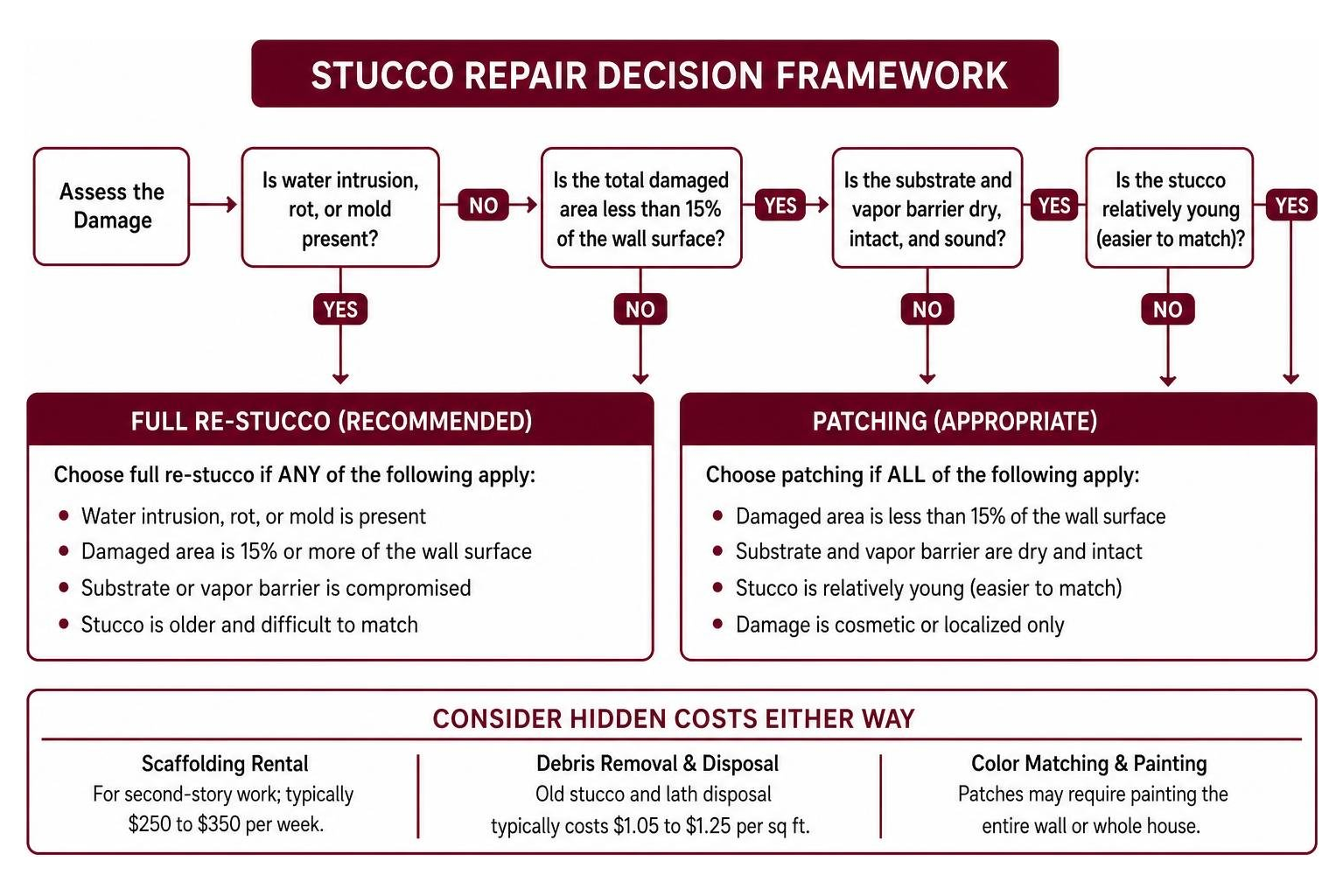
As a general rule of thumb, you should choose patching if:
- The total damaged area accounts for less than 15% of the wall’s surface.
- The underlying substrate and vapor barrier are completely dry and intact.
- The stucco is relatively young, making color and texture matching easier.
On the other hand, you should seriously consider a full re-stucco or resurfacing if:
- Damage exceeds 20% to 25% of the exterior surface.
- The stucco is delaminating (peeling away from the wall) in multiple areas.
- You are planning to sell your home soon and want to avoid massive buyer inspection discounts.
If you choose to resurface stable, intact stucco with a new finish coat, expect to pay between $10 and $18 per square foot. If you require a complete tear-off and a brand-new three-coat system, the cost typically ranges from $8 to $12 per square foot for installation, plus removal costs. You can estimate your specific wall area needs using the Stucco Cost Calculator 2026 to compare system types before signing a contract.
How to Get Accurate Stucco Repair Quotes and Avoid Pitfalls
Getting an accurate quote requires more than just calling the first name that pops up on Google. Because stucco repairs can quickly spiral in scope, you must protect yourself by being an informed consumer.
Vetting Contractors for Reliable Stucco Repair Quotes
When searching for a professional, look for contractors who specialize specifically in plastering and stucco remediation, rather than general “handymen.” Stucco is a highly technical trade that general contractors often subcontract out anyway, adding a 13% to 22% markup to your bill.
Always ask potential contractors for:
- Proof of active licensing and liability insurance.
- A fully itemized, written estimate that breaks down labor, materials, permits, disposal, and painting.
- References from local projects completed within the last two years.
- A clear explanation of how they handle “hidden damage” if they uncover rotted wood once they cut into the wall.
For more detailed advice on choosing a reputable local specialist, check out our guide on How to Choose the Right Stucco Repair Service.
The Danger of “Quick Fix” Caulk and Paint Solutions
The single biggest mistake we see homeowners make in Southeastern PA and New Jersey is falling for the “caulk and paint” trap. A cheap contractor will offer to seal your cracks with standard silicone caulk and paint over them for a few hundred dollars.
While this might look great for a few weeks, it is a disaster waiting to happen. Standard caulk shrinks and cracks over time, and if moisture is already trapped behind the stucco, sealing the exit point only accelerates the rot. Within 18 to 36 months, that $400 “quick fix” will trap water, causing the surrounding stucco to delaminate and leaving you with a $4,000 repair bill.
Before committing to any repair, always perform a simple “tap test” with a plastic mallet. If the wall sounds hollow, the stucco has already detached from the lath, and patching over it is guaranteed to fail.
Frequently Asked Questions about Stucco Repair Costs
Does homeowners insurance cover stucco repair?
In most cases, no. Homeowners insurance is designed to cover sudden, accidental damage—such as a tree falling on your house or hail damage from a severe storm. It specifically excludes gradual damage resulting from wear and tear, lack of maintenance, poor original construction, or slow water leaks. If your stucco is rotting because the original builder failed to install proper flashing around the windows twenty years ago, your insurance claim will almost certainly be denied.
How long does a professional stucco repair last?
A high-quality, professionally executed patch over a stable substrate should easily last 15 to 25 years. If you invest in a full, three-coat re-stucco, you can expect a lifespan of 50 to 80 years, provided you maintain it properly. To maximize this lifespan, we recommend inspecting your window and door caulking annually, performing a tap test every two to three years, and applying a high-quality elastomeric masonry coating every five to seven years.
Can I repair exterior stucco cracks myself?
If you are dealing with minor hairline cracks under 1/16 of an inch, a DIY repair is perfectly reasonable. You can purchase a premixed stucco patching compound for about $40 at your local home improvement store, clean out the crack, apply the patch, and paint over it. However, if the crack is wide, if the stucco sounds hollow when tapped, or if you suspect water has penetrated the wall, do not attempt a DIY fix. You run a high risk of sealing moisture inside your walls, which will lead to catastrophic structural rot.
Conclusion
At the end of the day, a stucco repair quote is only as good as the diagnosis behind it. If you patch the surface without addressing the root cause of the damage, you are simply throwing your hard-earned money away.
At Stucco Safe, we don’t perform repairs — and that is by design. We are independent, certified forensic stucco inspectors serving Southeastern Pennsylvania, New Jersey, and Delaware. Because we do not offer repair services, we have absolutely no financial incentive to find problems that don’t exist, nor do we have any reason to ignore hidden issues to secure a quick patching job.
Our professional stucco inspections vary in cost from $495 to $1,595 (or more for exceptionally large estate homes). Using state-of-the-art forensic testing methods, thermal imaging, and moisture meters, we provide you with an unbiased, detailed report of exactly what is happening behind your walls. Armed with this report, you can request highly accurate, competitive stucco repair quotes from local contractors, knowing exactly what needs to be fixed and preventing dishonest companies from overcharging you.
Before you sign a contract for thousands of dollars in repairs, make sure you know exactly what that crack is really costing you. If you are in Philadelphia, West Chester, Cherry Hill, Wilmington, or any of our surrounding service areas, contact us today to schedule your certified inspection, or visit our Stucco and Drywall Painting Company page to learn more about protecting your home’s exterior.