
The Ultimate Guide to Measuring Mold in Your Home
Moisture Meters vs. Mold Test Kits vs. Air Quality Monitors
To accurately measure mold in a house, we must first understand that mold is not a standalone air issue; it is a physical, structural issue. Mold does not grow in the air. It grows on and inside damp, organic building materials. Fungal spores are always floating around us, but they only settle down, grow roots (hyphae), and multiply when they find a consistent source of moisture.
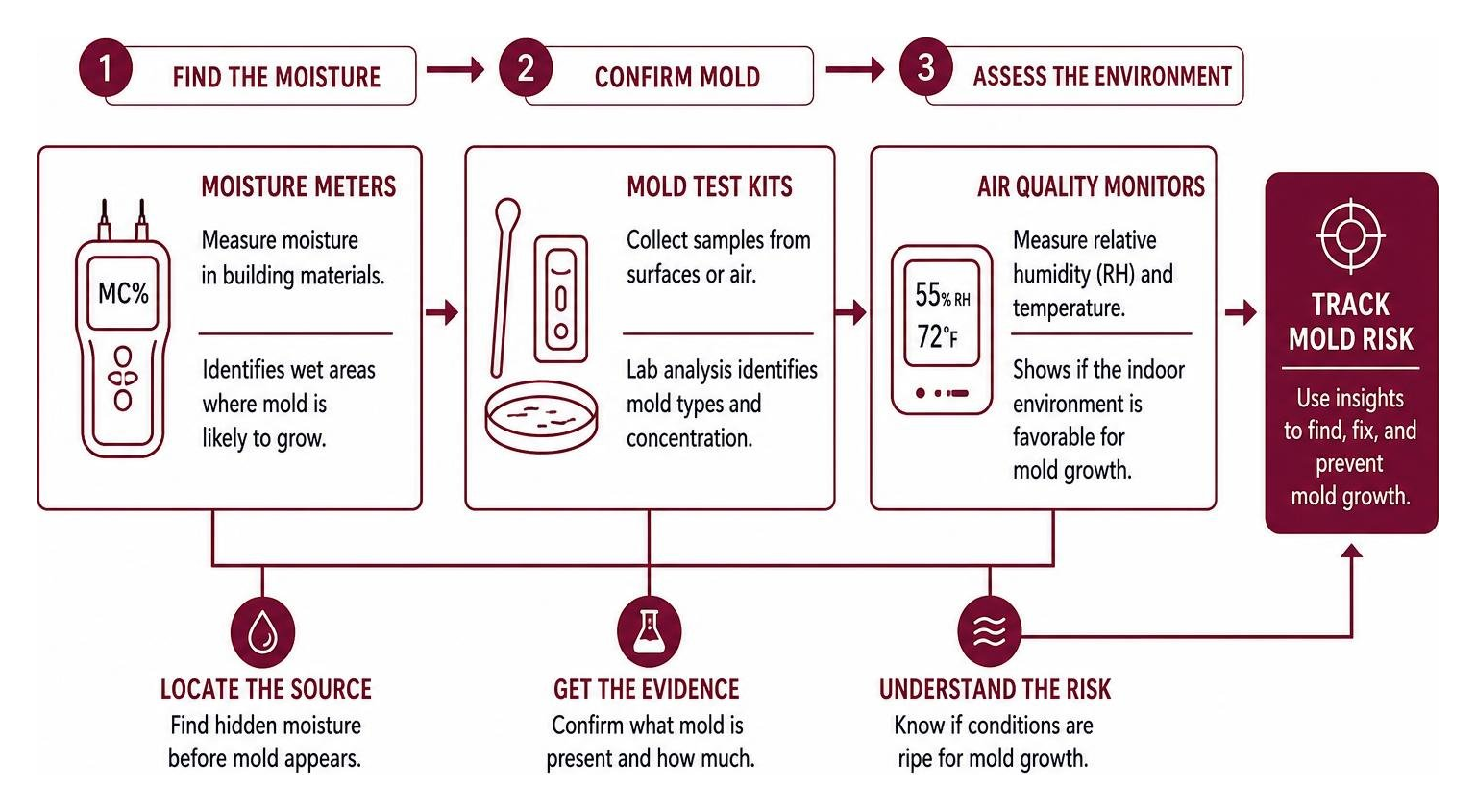
Because of this, different tools are designed to measure different parts of the mold lifecycle. To get a complete picture, we use three distinct classes of equipment:
- Moisture Meters: These are the first line of defense. They do not find mold spores directly. Instead, they measure the moisture content of building materials like drywall, plaster, wood, and masonry. By identifying wet building substrates, they pinpoint exactly where mold is highly likely to grow before it actually appears.
- Mold Test Kits: These tools collect physical evidence of mold. They use sticky tape, swabs, or vacuum cassettes to capture spores from surfaces or the air. These samples are then sent to an accredited laboratory to determine the exact genus and concentration of mold present.
- Air Quality Monitors: These devices track the surrounding environment. They measure relative humidity (RH) and ambient temperature. Because mold thrives in environments with relative humidity above 55%, these monitors tell you if your indoor air is ripe for a mold bloom, though they cannot locate a hidden leak behind a wall.
If you suspect an issue, running a random air test without mapping the moisture first is a waste of time and money. For a complete look at how these inspection strategies fit together, you can read our How to Check for Mold in a House: Full Guide as well as our deep dive on How Do You Test for Mold in Your Home?.
How to Measure Mold in House Environments Indirectly with Moisture Meters
Using a moisture meter to detect mold is an indirect method, but it is by far the most practical tool for preventative inspection.
When we use a moisture meter, we are measuring the physical and biological timeline gap. Mold requires a damp substrate to germinate. By measuring the moisture content (MC) of drywall or wood, we can identify “micro-wet zones” where the conditions are perfect for fungal growth. This is particularly useful in stucco homes across Southeastern Pennsylvania, New Jersey, and Delaware, where wind-driven rain can seep behind the exterior cladding and saturate the plywood sheathing long before any visible signs appear inside the home.
If we wait to see physical mold growth, we are already dealing with structural damage and airborne contamination. Using a moisture meter allows us to intercept the moisture pathway early. You can learn more about choosing the right tool for this in our guide on Mold Meter Mania: Finding the Best Device to Keep Your Home Dry and read about the science behind material moisture mapping in Can a Moisture Meter Detect Mold? Thresholds & Scanning Workflow.
Direct Spore Testing and Air Quality Monitoring
While moisture meters locate the risk, direct testing confirms the reality. Direct spore testing is necessary when you need to know exactly what species of mold are present, especially if family members are experiencing unexplained respiratory symptoms.
Professional air sampling involves drawing a calibrated volume of air through a specialized collection cassette (often called a spore trap, such as an Air-O-Cell cassette). This traps airborne spores on a sticky slide, which a laboratory technician analyzes under a microscope.
If you want to perform an initial screening yourself, high-quality consumer options like the GOT MOLD? Test Kit, the My Mold Detective Mold Test Kit, or a 1-Room Mold Test Kit can collect air samples to send to accredited labs.
For more details on how these air tests are analyzed and interpreted, see our resources on Mold Air Testing and Test for Mold Spores: Methods, Kits, and Lab Analysis – InspectandTest.
Substrate Moisture Thresholds for Mold Risk
To successfully measure mold in a house, you must know what the numbers on your moisture meter actually mean. Different building materials have different densities, porosities, and water-holding capacities. A reading that is perfectly safe for a concrete floor would indicate a severe, active leak if found in drywall.
According to industry standards like the IICRC S520-2015 and the EPA, here are the moisture content (MC) thresholds that signal mold risk across common building substrates:
| Building Material | Safe Zone (Low Risk) | Caution Zone (Monitor Closely) | Mold Risk Zone (Action Required) |
|---|---|---|---|
| Gypsum Drywall | < 12% MC | 12% – 16% MC | > 16% MC (Colonization begins here) |
| OSB / Plywood Subfloors | < 16% MC | 16% – 19% MC | > 19% MC (Sustained risk above 20% MC) |
| Softwood Framing Lumber | < 19% MC | 19% – 25% MC | > 25% MC (Active decay and rot risk) |
| Concrete Slab | < 75% RH | 75% – 85% RH | > 85% RH (Requires specialized RH probe) |
Note: The EPA (2024 guidelines) warns that sustained moisture content above 20% MC in any cellulose-based building material creates highly favorable conditions for rapid mold colonization.
Understanding these thresholds is critical. For example, in New Jersey and Pennsylvania, the high summer humidity can cause surface materials to absorb ambient moisture. However, if your drywall reads above 16% MC, you are no longer dealing with simple humidity—you have an active moisture intrusion problem.
To learn more about how state agencies view these standards, check out the Department of Health | Environmental Health | Mold – NJ.gov guidelines, and read our comprehensive walkthrough: Don’t Get Damp: A Homeowner’s Guide to Moisture and Mold Inspections.
How to Measure Mold in House Substrates: A Step-by-Step Scanning Workflow
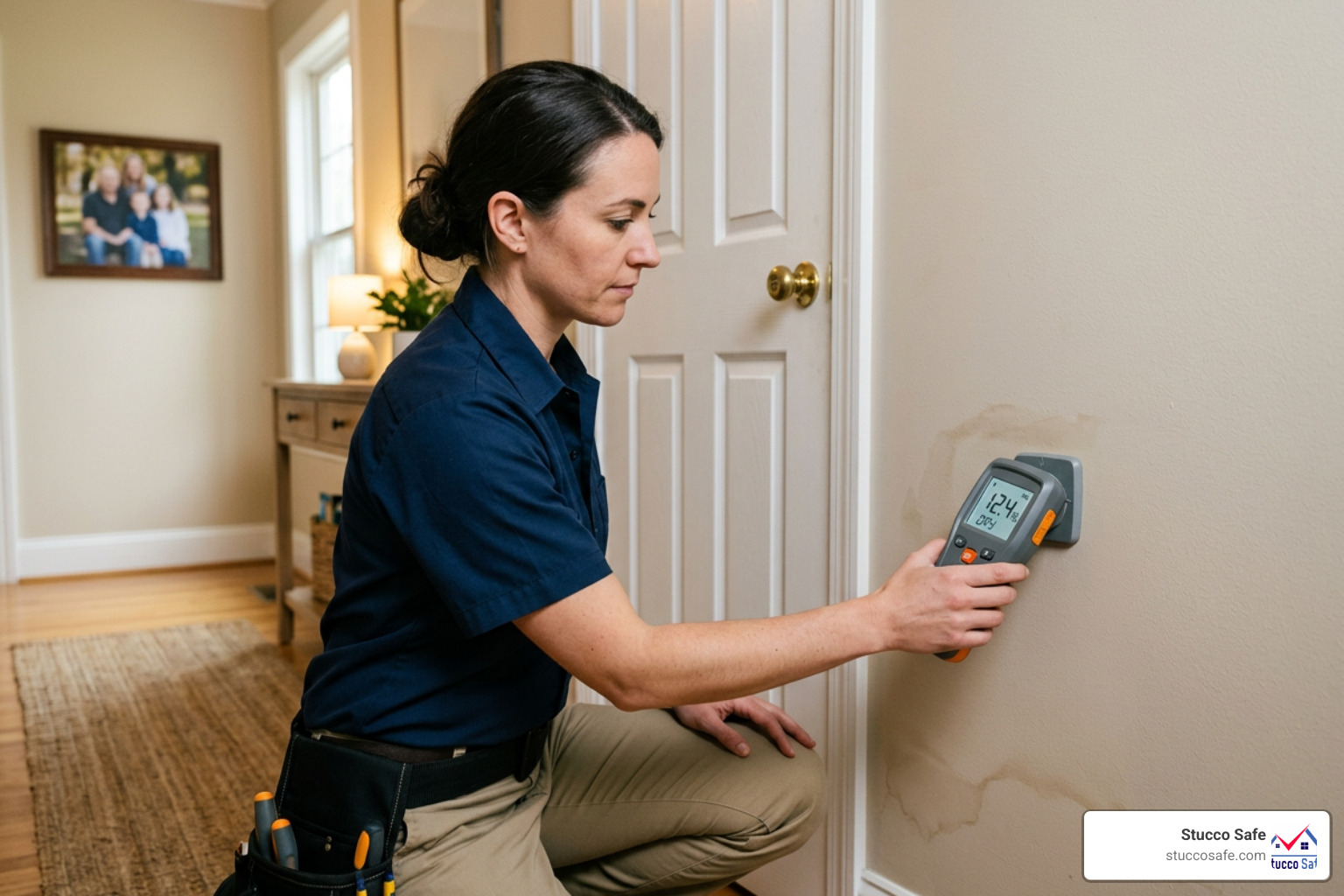
When we inspect properties throughout Philadelphia, West Chester, and Villanova, we don’t just poke a meter into the wall randomly. To get accurate results, you must follow a methodical, forensic scanning workflow.
Here is the exact step-by-step process we use to scan for mold and moisture risks:
- Set Your Meter to the Correct Mode: If your meter has material settings, make sure it is set to “drywall mode” for gypsum walls or “wood mode” for framing and subfloors.
- Establish a Dry Baseline: Find an interior wall that you know is dry (such as a partition wall far away from any plumbing, windows, or exterior stucco). Take three readings and average them. This is your “dry standard” for the house.
- Execute a Grid Scan: Move to your target area (e.g., beneath a window, near a shower, or along an exterior stucco wall). Place your pinless meter against the wall and scan in a 12-inch grid pattern, moving both horizontally and vertically.
- Map the Wet Boundary: If your meter’s reading jumps above the dry baseline, mark the edges of the elevated readings with light pencil marks or painters tape. This allows you to visualize the exact shape of the moisture pathway.
- Perform a 24-Hour Rescan: Record your readings, wait exactly 24 hours, and test the exact same spots again.
This structured approach is the key to accurate diagnostics. For a deeper look at physical testing procedures, review our guide on How to Test for Mold.
Surface vs. Depth Measurements
One of the most common ways homeowners get a false sense of security is by relying solely on surface readings. Fungi love to grow in dark, unventilated spaces—which means the mold is almost always growing on the back side of the drywall, inside the wall cavity, or within the wood framing.
A wall can feel dry to the touch, and a cheap pinless meter might show a normal surface reading. However, the gypsum core or the wood studs deep inside the wall could be completely saturated.
- Pinless Scanning (Surface/Shallow Depth): Pinless meters use electromagnetic signals to scan up to 3/4 of an inch deep without damaging the wall. They are fantastic for rapid scanning, but they can be fooled by surface condensation or metal studs.
- Pin-Type Probes (Deep/Core Measurement): Pin-type meters use electrical resistance to measure moisture between two uninsulated pins. By pushing insulated pins deep into the material, we can bypass the dry surface and measure the core moisture. If the core moisture is elevated, mold hyphae (the root structures of mold) are likely already penetrating deep into the substrate.
To understand why surface-level “digital detectors” often miss the real threat, read our article Beyond the Hype: Unmasking the Digital Mold Detector Myth.
Grid Scanning and the 24-Hour Rescan Rule
Why is the 24-hour rescan rule so critical?
A single point reading is just a snapshot in time. It cannot tell you whether a material is actively drying out or actively absorbing water.
For instance, if you scan a wall on a Monday and get a caution-zone reading of 14% MC, that number alone doesn’t tell the whole story. If you scan it again on Tuesday:
- If the reading drops to 11% MC: The material is actively drying. The source of water has likely stopped, and the risk of mold colonization is decreasing.
- If the reading rises to 18% MC: You have an active, ongoing leak. Moisture is actively migrating into the wall cavity, and mold colonization is almost guaranteed if it isn’t addressed immediately.
Sustained moisture is what allows mold to flourish. A brief spill that dries within 24 hours will not cause mold; a slow, hidden weep from a pipe or stucco failure that keeps the drywall at 17% MC for days will. We discuss this dilemma further in The DIY Mold Test Dilemma – Are You Really Getting Reliable Results?.
Common Mistakes When You Measure Mold in House Walls
When homeowners try to measure mold in a house without professional training, they often make a few classic mistakes that lead to incorrect conclusions:
- Calibration Errors: Using “wood mode” to read drywall. Because wood is far denser than gypsum, using the wrong mode will significantly underestimate the actual moisture content of your walls.
- Ignoring Ambient Relative Humidity: In hot, humid summers in places like Delaware or Camden, NJ, the ambient indoor humidity can easily rise above 60%. When this happens, surface materials absorb moisture from the air, which can cause elevated readings even if there are no active plumbing or roof leaks.
- Neglecting the Dew Point (The 55°F Threshold): Mold doesn’t need a massive flood to grow; it just needs moisture. At a 55°F dew point, any cold corner of a room (such as behind furniture against an exterior wall or in a cold corner of a basement) that regularly dips below this temperature will experience micro-condensation. This creates a perfect, damp microclimate for mold to colonize, even if the rest of the room feels warm and dry.
To avoid these pitfalls and learn how to properly evaluate your home, see our guide: How Can You Check for Mold in Your House?.
When to Call a Professional Mold Inspector
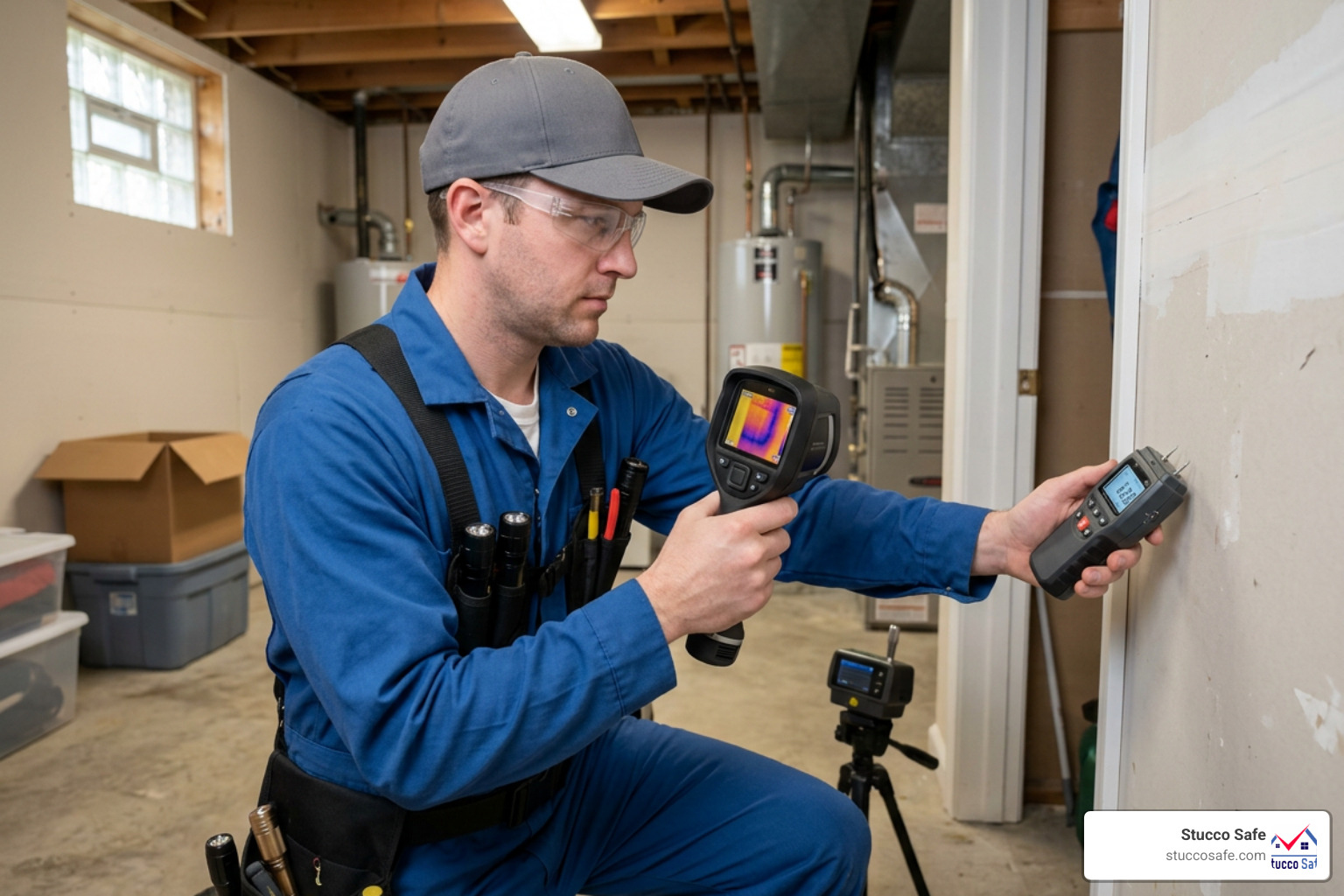
While DIY moisture meters and test kits are excellent for basic screening, there comes a point where you need to step back and call in a certified professional.
According to the Environmental Protection Agency (EPA), the clear threshold for DIY cleanup is 10 square feet of visible mold. If the mold covers an area larger than a standard 3-foot by 3-foot patch, trying to clean it yourself without professional containment can release millions of spores into your indoor air, spreading the contamination to other rooms.
You should always call a professional inspector if:
- You suspect hidden mold: If you smell a persistent musty odor but your moisture meter scans are inconclusive, or if you suspect water is trapped behind your stucco cladding.
- There is structural damage: If drywall is soft, crumbling, or buckling, or if floorboards are warped.
- Occupants are experiencing health symptoms: If anyone in the home has unexplained asthma, chronic sinus infections, or compromised immune systems.
- You are dealing with stucco or exterior envelope leaks: In our service areas of Southeastern PA, New Jersey, and Delaware, stucco homes are uniquely vulnerable to hidden moisture intrusion. Standard interior scans often cannot detect the water trapped deep within the exterior wall assembly.
For professional assistance, we recommend hiring certified inspectors who use forensic testing methods to find the root cause of the moisture. You can learn more about what to look for in our guide on choosing an Inspector for Mold.
Frequently Asked Questions about Measuring Mold
Can a moisture meter detect mold behind drywall?
No, a moisture meter cannot directly identify mold spores or confirm if mold is currently growing behind drywall. However, it detects the conditions that allow mold to grow.
If you use a pin-type meter with insulated probes and get a reading above 16% MC deep inside the drywall core, you have confirmed that the cavity contains enough moisture to sustain mold colonization. Because mold grows into porous materials rather than just on them, a wet gypsum core is a highly reliable indicator of hidden mold risk. For a complete look at finding these hidden issues, check out our Detect Mold House Complete Guide.
What is the difference between mold and mildew?
Mildew is a superficial, surface-level mold. It typically grows in flat, powdery patterns (often white, gray, or yellow) on non-porous surfaces like bathroom tile, grout, or shower curtains. It does not penetrate deep into substrates and can usually be wiped away easily with household cleaners.
True mold, however, penetrates deep into porous materials like drywall, wood, and carpet. It grows branching, root-like structures called hyphae that digest the organic material itself, eventually causing structural rot and decay. While mildew is a minor cosmetic nuisance, deep mold growth can destroy building materials and requires professional remediation. For help identifying what you are looking at, read our Visual Mold Inspection Ultimate Guide.
How much does a professional mold inspection cost?
A professional stucco and moisture inspection typically varies in cost from $495 to $1,595 or more for very large homes. This cost reflects the specialized forensic equipment used, the certification of the inspectors, and the depth of the thermal imaging and moisture mapping performed.
While a cheap DIY kit might cost under $50, it cannot provide the liability-backed, scientific documentation required for real estate transactions or insurance claims. For more details on professional pricing and what’s included, see our guide on Home Inspector Mold Testing.
Conclusion
Learning how to measure mold in a house is the single best way to protect both your health and your property. By using moisture meters to map wet building materials and tracking relative humidity, you can catch water intrusion before mold has a chance to colonize your home.
If you are buying a home or suspect moisture issues in Southeastern Pennsylvania, New Jersey, or Delaware—especially in stucco-clad properties—don’t leave it to guesswork. At Stucco Safe, we use advanced forensic testing methods and certified inspectors to locate hidden moisture and protect your investment.
Ready for peace of mind? Schedule a Home Mold Inspection with us today, and let our team of experts ensure your home stays dry, safe, and mold-free.