
Why Every Home Needs a Building Envelope Inspection
What a Building Envelope Inspection Reveals — And Why It Matters for Your Home
A building envelope inspection is a professional evaluation of every system that separates the inside of your home from the outside world — including your roof, exterior walls, windows, doors, foundation, and the moisture barriers behind them.
Here is what a building envelope inspection typically covers:
- Roof — condition, drainage, flashing, and remaining service life
- Exterior walls and cladding — stucco, EIFS, masonry, siding; checked for cracks, missing sections, and moisture intrusion
- Windows and doors — seals, frames, and weathertightness
- Foundation walls — signs of water infiltration or structural movement
- Air and vapor barriers — continuity, penetrations, and adhesion
- Ventilation systems — proper airflow ratios and moisture control
When any one of these systems fails, the consequences can spread quickly. As one real-world example illustrates: a single open joint at a parapet cap can allow water to enter a wall, rust the steel framing, saturate the insulation, and eventually cause roof leaks — all from one small, overlooked gap.
For homeowners with stucco exteriors, the stakes are especially high. Research suggests that more than 90% of stucco applications in the Northeastern United States over the past 15 to 20 years were improperly installed. Problems often stay hidden behind the surface for years before visible damage appears.
I’m Gabe Kesslick, and I’ve been specializing in leak detection, stucco forensics, and building envelope inspection since 2001, holding certifications from EDI, AWCI, BESI, and the Moisture Warranty Corporation. In this guide, I’ll walk you through exactly what a thorough inspection involves and why it’s one of the most important steps you can take to protect your home.
What is a Building Envelope and Why Does It Matter?
Think of the building envelope as the “skin” of your home. Just like your skin protects your organs from the environment, the building envelope protects the interior of your home from wind, rain, heat, and cold. It is a complex assembly of materials working together to create an environmental separator.
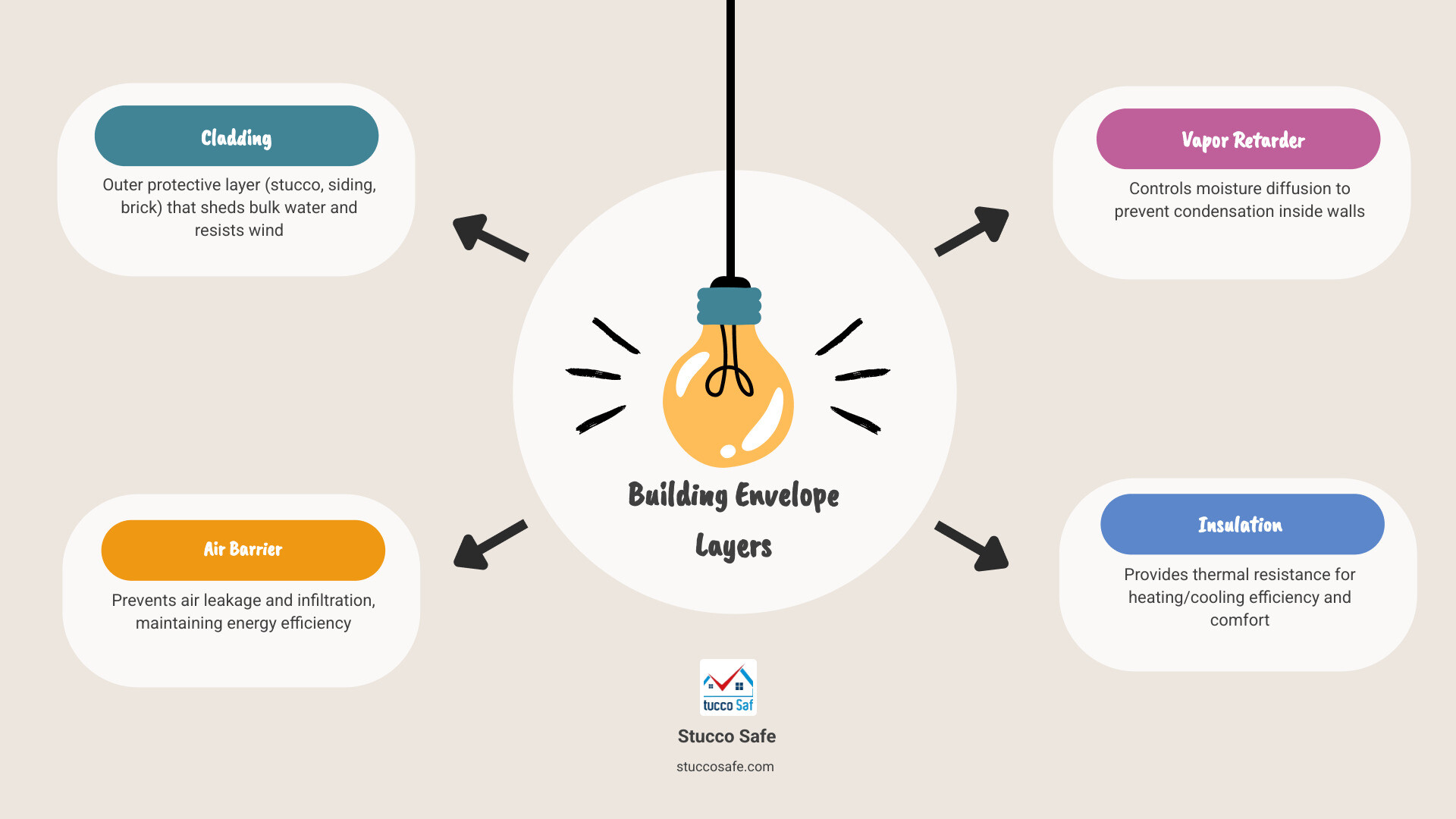
When we talk about the envelope, we are looking at several critical layers:
- The Thermal Envelope: This includes your insulation and helps maintain the temperature inside.
- The Air Barrier: This prevents uncontrolled air leakage, which can skyrocket your energy bills.
- The Vapor Retarder: This controls how moisture moves through your walls to prevent condensation and mold.
The importance of this system cannot be overstated. A well-functioning envelope ensures energy efficiency, prevents the growth of toxic mold, and maintains the structural durability of the framing. If you want to dive deeper into the technical workflow, you can check out this Building Envelope Assessment Steps | ABSI Guide for a look at the professional process.
Understanding the Different Types of Envelopes
Not all buildings are wrapped the same way. Depending on the design and location—whether you’re in a breezy coastal area of New Jersey or a dense urban environment like Philadelphia—the type of envelope matters:
- Singular Envelope: A traditional setup where all functions (water, air, and thermal control) are integrated into one main system, like masonry walls.
- Double Envelope: Often used in modern designs to create an extra buffer zone for better insulation and moisture control.
- Pressure-Balanced System: These are ingenious designs that use vents to equalize air pressure. They are particularly effective for high-rise buildings facing heavy wind loads, as they prevent wind-driven rain from being sucked into the wall cavities.
- Dynamic Envelope: These high-tech systems can actually adapt to environmental changes, such as using automated shading or ventilation to regulate temperature.
Core Components of a Building envelope inspection
When we arrive at a property in West Chester or Cherry Hill for a Building envelope inspection, we don’t just walk around and look for cracks. We follow a systematic approach to evaluate every component.
Inspecting Exterior Walls and Cladding
The exterior walls are the most visible part of the envelope, but they are often the most misunderstood. We look for specific deficiencies that might seem minor to a homeowner but are major red flags to a forensic inspector.
For example, HUD standards for exterior walls are quite specific about what constitutes a “Moderate Health and Safety” deficiency. According to the HUD Exterior Wall Standards, missing sections of wall covering as small as 1 square foot or peeling paint covering 10 square feet or more on a single wall require correction within 30 days.
In our region—Southeastern PA, NJ, and Delaware—stucco and EIFS (Exterior Insulation and Finish Systems) are incredibly common. Because these systems are often “non-draining,” any water that gets behind them stays there, rotting the wood sheathing and framing. We specialize in Building Envelope Inspection Services that specifically target these hidden moisture traps.
Roofing and Ventilation Standards
Your roof is your first line of defense, but it has a shelf life. We use industry data to help homeowners understand when they are living on borrowed time:
- Asphalt Shingles: Typically last about 20 years for a single layer. If a second layer was added over the first, that second layer usually only lasts about 15 years.
- Wood Shingles/Shakes: These have a normal life expectancy of 25 to 30 years, provided they aren’t in excessively hot and humid climates.
- Single-Ply Membranes: Common on flat roofs, these generally last about 20 years if maintained.
Ventilation is the “secret sauce” of a healthy roof. Without proper airflow, moisture builds up in the attic. The Residential Inspection Guide notes that for a crawl space with an earthen floor, the free vent area to floor area ratio should be 1 to 150. We check these ratios in both attics and crawl spaces to ensure your home can “breathe” properly.
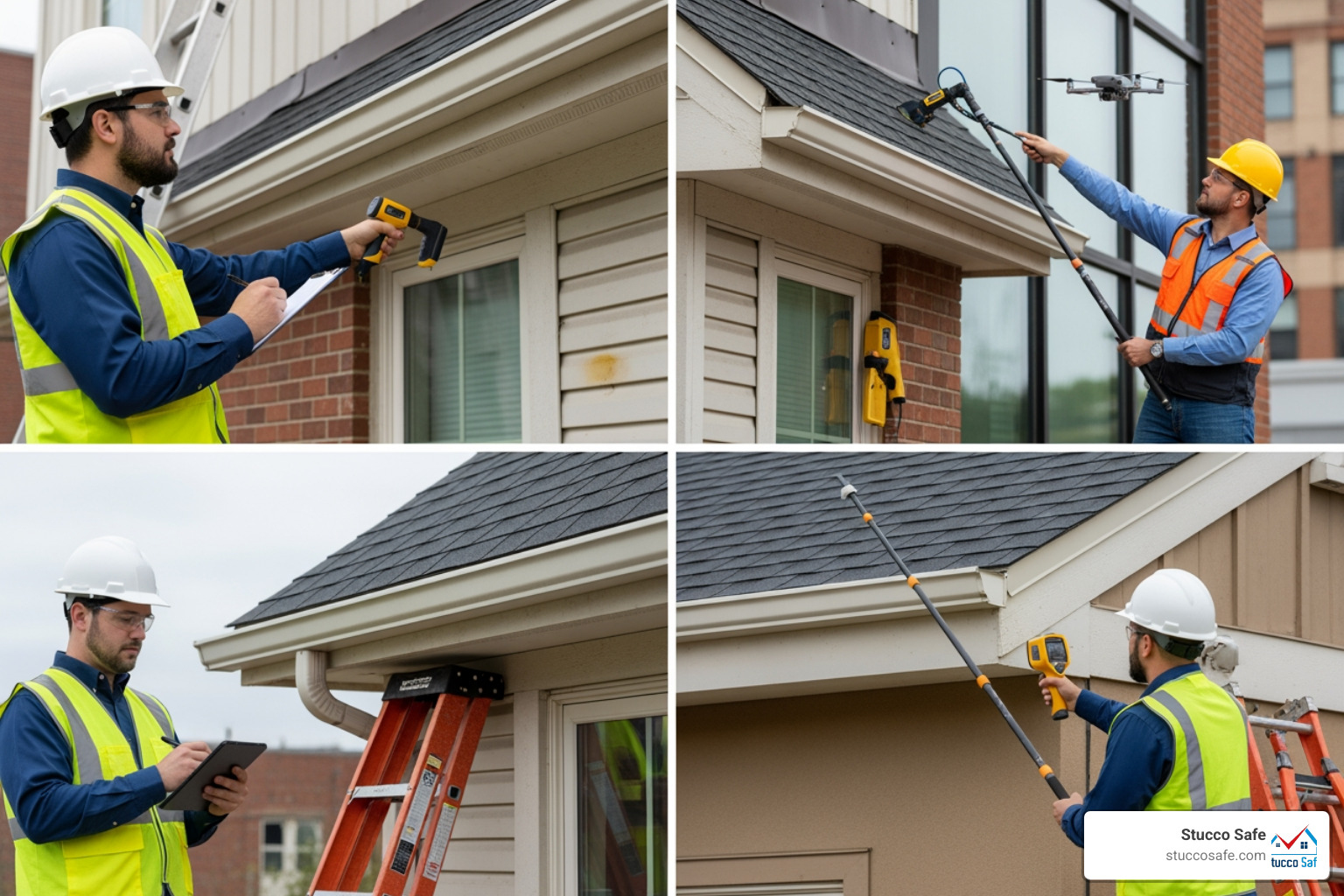
Advanced Tools Used in a Professional Assessment
Gone are the days when an inspector could just use a flashlight and a ladder. Today, we use forensic technology to see what the human eye cannot.
The Role of Infrared Scanning in a Building envelope inspection
Infrared thermography is a game-changer. It allows us to detect “thermal anomalies”—spots where heat is escaping or where moisture is trapped inside a wall. Moisture has a different “thermal capacitance” than dry wood or insulation, meaning it holds heat longer.
To get an accurate reading, we follow the Infraspection IR Standard. This requires a temperature difference of at least 10°C (18°F) between the inside and outside of the building for at least three hours prior to the test. This is why we often perform these scans in the early morning or late evening when the temperature contrast is highest.
Specialized Testing for Air and Water Infiltration
Beyond the camera, we use a variety of physical tests:
- Moisture Mapping: Using tools like the Tramex CMEXPERT, we can create a “map” of moisture levels across a surface without causing damage.
- Water Penetration Spray Testing: We literally spray water at windows and walls at specific pressures to see if they leak.
- Blower Door Tests: We depressurize the house to find exactly where air is leaking through the envelope.
- Roof Uplift Resistance: This checks if the roof membrane is actually stuck down well enough to survive a Jersey Shore windstorm.
| Feature | Visual Inspection | Forensic Testing |
|---|---|---|
| Detection Method | Human Eye / Flashlight | Infrared, Moisture Meters, Drones |
| Accuracy | Subjective / Limited | Objective / Data-Driven |
| Hidden Issues | Misses rot behind walls | Identifies latent moisture |
| Cost | Lower | Higher (but saves more in repairs) |
Identifying Common Deficiencies and Health Risks
Why do we care so much about a little water? Because water is the “universal solvent” for a building. Common deficiencies we find include missing expansion joints in stucco, improper flashing around windows, and lack of “weep screeds” that allow water to exit the bottom of a wall.
When these issues are ignored, the health risks are real:
- Mold Growth: Moisture trapped in walls is the perfect breeding ground for mold, which can destroy indoor air quality.
- Structural Rot: We have seen homes where the main structural studs have turned into the consistency of wet cardboard due to long-term leaks.
- Pest Infestation: Termites and carpenter ants are attracted to damp wood. A compromised envelope is an open invitation for a colony to move in.
- Energy Loss: “Thermal bridging” occurs when heat bypasses your insulation through structural members, making your HVAC system work twice as hard.
When to Schedule a Professional Assessment
We often tell our clients in places like Villanova and King of Prussia that an inspection is an investment, not an expense.
- Pre-Purchase Vetting: Never buy a stucco or EIFS home without a dedicated Building envelope inspection. A standard home inspection often misses the forensic details needed to find hidden rot.
- Seller’s Pre-Listing: If you’re selling, getting an inspection first puts you in the driver’s seat. It allows you to fix issues on your own terms rather than being hit with a massive price reduction at the closing table.
- Post-Storm Evaluation: After a major weather event, it’s worth checking if your seals were compromised.
- Annual Maintenance: Just like you change the oil in your car, your home’s exterior should be checked regularly.
Why DIY is Not Recommended for a Building envelope inspection
We love a good DIY project as much as anyone, but the building envelope is not the place for it. Forensic expertise requires years of training to interpret thermal images correctly. A “cold spot” on a camera could be moisture, but it could also just be a missing piece of insulation or a reflection.
Furthermore, specialized equipment like high-resolution thermal cameras and calibrated moisture meters costs thousands of dollars. More importantly, most insurance companies and warranty providers, like the Moisture Warranty Corporation, require a certified professional to sign off on the report for it to be valid.
Frequently Asked Questions about Envelope Assessments
How often should a building envelope be inspected?
Ideally, you should have a professional look at your envelope every few years, but you should do a personal walk-around twice annually—once in the spring and once in the fall. Look for peeling paint, cracked caulking, or gutters that aren’t draining.
What is the difference between a general home inspection and an envelope assessment?
A general home inspection is a “mile wide and an inch deep.” They check if the lights turn on and the toilets flush. A Building envelope inspection is a “foot wide and a mile deep.” We focus exclusively on the integrity of the exterior systems using forensic tools that general inspectors typically don’t carry.
What should be included in a comprehensive inspection report?
A professional report from Stucco Safe includes:
- Clear photos of every deficiency found.
- Infrared thermograms showing heat and moisture patterns.
- Specific moisture readings from invasive or non-invasive testing.
- A prioritized list of recommendations (what needs to be fixed now vs. what can wait).
- Estimated timelines for repairs.
Conclusion
Your home is likely your largest financial investment. Protecting its structural integrity through a regular Building envelope inspection is the best way to ensure long-term savings and peace of mind. Whether you are in Newark, Edison, or right here in West Chester, don’t let a small leak turn into a structural disaster.
At Stucco Safe, we bring forensic precision to every job, ensuring that “90% failure rate” doesn’t include your home. We serve all of Southeastern Pennsylvania, New Jersey, and Delaware with certified expertise.
Get a Professional Stucco Inspection today and let us help you protect what matters most. Our inspections typically range from $495 to $1595, a small price to pay to avoid a $50,000 remediation bill down the road.